
How an AI Trip Planner Actually Works (Without the Fluff)

See how an ai trip planner works and craft realistic, burnout-free itineraries you'll actually use.
An AI trip planner is a tool that builds a logical, day-by-day travel schedule for you in seconds. It sorts through the noise of conflicting blog posts and endless options to deliver a time-blocked itinerary based on your interests and pace, saving you from the hours of research and spreadsheet headaches. The goal is a burnout-free trip, not just a list of tourist traps.
Let's be honest: planning a trip has become a chore. It starts with a spark of excitement that quickly gets buried under an avalanche of browser tabs, contradictory blog posts, and a spreadsheet that gives you a headache just looking at it.
An AI trip planner cuts through that noise. It's not just another list of sights; it's a personal travel strategist. It takes your destination, interests, and how you like to travel, then builds a day-by-day, time-blocked schedule. This saves you from the mind-numbing research and answers the real question: how do you actually see a city without getting completely overwhelmed?
So, what does an AI trip planner really do?

Last time I was in Lisbon, I spent hours trying to figure out if seeing Belém Tower was better in the morning or afternoon, how to logically group sights in the Alfama district, and where to eat that wasn't a tourist trap. The decision fatigue was intense.
That’s the exact chaos an AI trip planner is built to solve. It’s not a search engine spitting out the same top-10 list you've already seen. Think of it more like an experienced local friend who knows the city's rhythm and flow.
Is it just another gimmick?
That's a fair question, especially with AI being slapped onto everything these days. Here’s the truth: many so-called "planners" are just a flimsy front for a basic AI that generates a simple list of popular spots. A good AI trip planner, however, does something fundamentally different—it tackles the logistics that cause most of your travel stress.
The real challenge isn't figuring out what to see. It's knowing when and in what order to see everything to avoid crowds, transit nightmares, and total burnout. A good planner solves the logistical puzzle, not just the discovery one.
Instead of just telling you to visit the Colosseum, a smart planner might suggest going late in the afternoon, after the tour bus crowds have thinned. It won't have you zigzagging across Paris; it'll group activities into walkable neighborhoods. This is the difference between a simple checklist and a real strategy.
The goal of an ai trip planner isn’t just to fill your schedule but to make your time feel more intentional and a lot less frantic. It’s for people who want to spend less time planning and more time actually experiencing the destination. If you're curious about how different tools compare, you might find our guide on the best AI travel planner helpful.
So, how does an AI actually build your trip?
Let's peek behind the curtain. Forget the complex jargon for a second. Imagine you've hired an incredibly knowledgeable personal assistant. You give this assistant your core requests: where you're going, for how long, what you love to do, and whether you prefer a packed schedule or a relaxed pace. The assistant then consults a massive, ever-growing encyclopedia of travel knowledge—everything from museum opening hours and metro schedules to real-time crowd data and hidden local spots.
It’s this combination of raw data and smart sequencing that turns a list of places into a genuinely useful, day-by-day guide.
The two halves of a smart planner's brain
The process isn't magic. It's really about two different kinds of intelligence working together. A good AI trip planner needs both to create something that's both interesting and practical. If one part is missing, you either get a beautiful but impossible plan, or a boring list of places with no context.
-
Generative AI: This is the creative part. It takes all the raw data and weaves it into a narrative you can actually follow. It’s what writes, "After a morning exploring the Colosseum, grab a classic Roman lunch at a trattoria in the Monti neighborhood before a short walk to the Roman Forum." It makes the plan feel human.
-
Travel Data: This is the hyper-organized fact-checker. This massive database provides the critical real-world context. It knows the Colosseum has timed entry tickets that sell out, that most restaurants in Monti close between lunch and dinner, and that walking to the Forum from there only takes about 10 minutes. It keeps the plan grounded in reality.
Here’s a look at how the WanderAssist planner interface translates all that complex data into a simple, time-blocked schedule you can actually use.
See how it’s more than just a list? The activities are organized by time and location, creating a natural flow for your day. That logical structure is what separates a truly helpful tool from a frustrating one.
How does WanderAssist build a realistic itinerary?
Many basic AI tools just spit out a list of popular attractions, leaving you to figure out the logistics. This is where a more sophisticated, "reality-aware" system makes all the difference. We built WanderAssist on two simple but powerful principles to make sure your plan is actually enjoyable, not just a frantic dash from one side of town to the other.
A plan from an AI is only as good as the real-world logic it's built on. A great itinerary isn't about cramming in the most sights; it's about experiencing the right things at the right time and in the right order.
First, we use temporal logic. It's a fancy term for a simple idea: timing is everything. Our "Timing Tips" schedule your visit to popular spots when they’re likely to be less crowded, making the whole experience better.
Second, we use neighborhood anchoring. This means we group your activities by district, so you can explore a specific area on foot. This simple trick drastically cuts down on transit fatigue and prevents that all-too-common feeling of spending half your vacation on a bus or subway.
This kind of intelligent grouping is what transforms a random list of ideas into a calm, actionable plan for your day. It’s no surprise that the demand for these smarter tools is exploding; the generative AI in travel market is projected to hit USD 5,788.55 million by 2035. You can read the full research about AI's expanding role in travel to see just how big this is getting.
Is an AI trip planner right for your travel style?
No two travelers are the same, so a cookie-cutter itinerary is bound to fail. The real value of a good AI trip planner isn't just that it creates a schedule; it's that it builds one around you—whether you're a first-timer staring at a giant map in a panic or a seasoned pro who just doesn't have the time to do it all yourself anymore.
I learned this the hard way trying to organize a big family trip. My parents wanted a relaxed pace with long lunches, while my younger cousins had a "see everything now" mentality. The debates were endless. An impartial AI could have been the perfect mediator, balancing everyone's preferences and desired pace to give us a neutral starting point, saving us a ton of friction.
Who benefits the most from an AI planner?
Different travel styles call for different planning approaches. Here’s a quick look at how an AI-powered tool can adapt to common traveler archetypes:
- The First-Time Visitor: You're overwhelmed by options and plagued by the fear of missing out. An AI planner brings order to the chaos, grouping sights logically so you can hit all the major landmarks without zigzagging across the city and burning out by day two.
- The Busy Professional: Your time is your most precious commodity. The AI does the heavy lifting, condensing hours of research into a few seconds to deliver a polished, ready-to-go plan. For more ideas on maximizing short trips, check out our guide on how to plan a weekend getaway.
- The Family Planner: Juggling the needs of toddlers, teens, and adults is a logistical nightmare. A smart planner can build a schedule with kid-friendly activities, built-in downtime, and a pace that keeps everyone happy (or at least, not complaining).
- The Spontaneous Traveler: You love to go with the flow, and that's great. But even a wanderer needs a place to start. An AI plan provides a solid, well-researched foundation you can freely deviate from the moment a cool-looking alleyway or hidden cafe catches your eye.
The process is surprisingly straightforward: you provide your preferences, the AI engine crunches the data, and it spits out a structured itinerary.
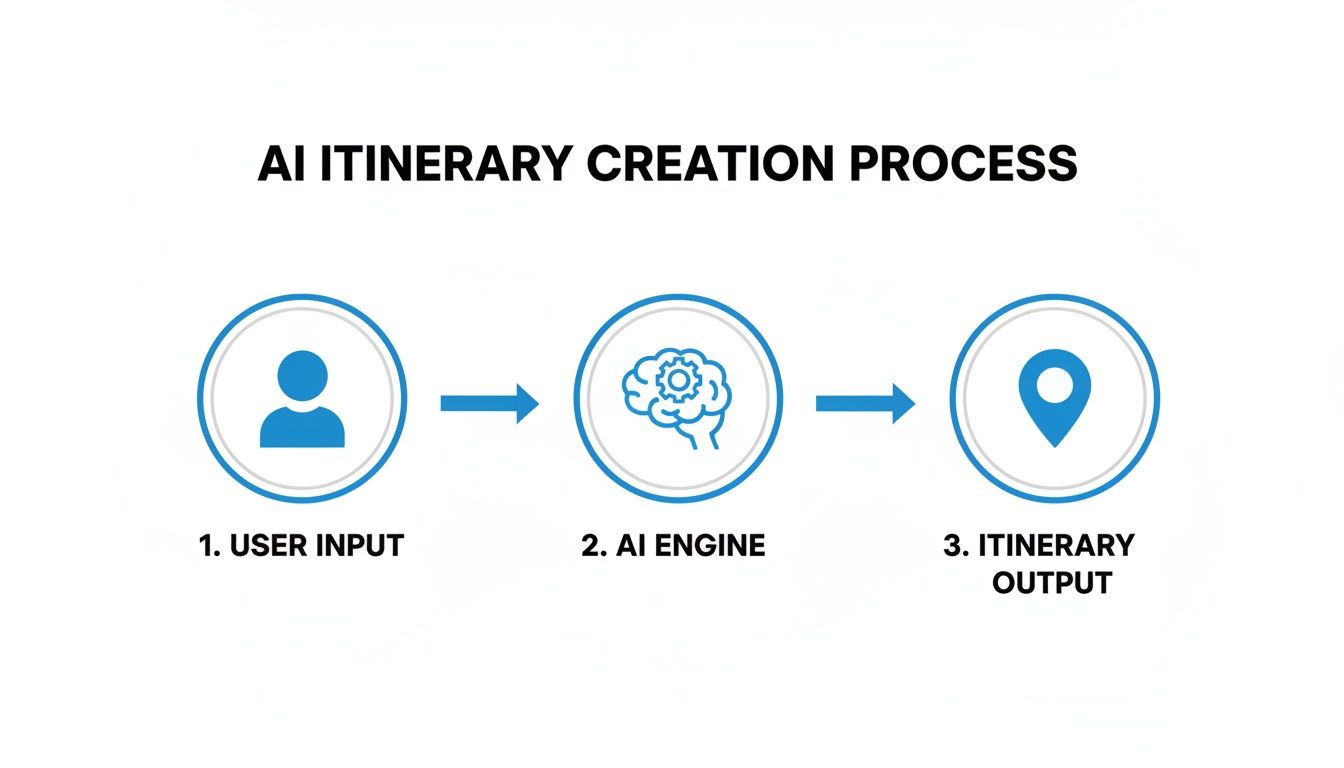
The key takeaway here is that the quality of your itinerary depends entirely on the logic baked into that AI engine. A simple one gives you a list; a smart one gives you a real plan.
Is this really a mainstream tool now?
Absolutely. AI trip planning has officially moved from a niche tech curiosity to a common travel tool. Recent data shows that 39% of U.S. travelers have already used AI for travel research, with 58% of U.S. millennials leading the pack.
What's really telling is that 96% of people who've tried it for planning say they'll probably use it again. That's a massive satisfaction rate, and it proves these tools are solving a real problem. Discover more insights about how AI is changing travel planning.
This shift isn't surprising. The benefits are just too obvious to ignore—saving time and reducing the mental burden of planning are pain points that virtually every traveler feels.
To really see the difference, let’s compare the old way of doing things with the new AI-powered approach.
Travel planning: the old way vs the AI way
| Planning Aspect | The Old Way (Manual Research) | The AI Way (WanderAssist) |
|---|---|---|
| Time Investment | 10-20+ hours of searching blogs, guides, and reviews. | ~60 seconds of inputting preferences. |
| Information Overload | Juggling dozens of browser tabs and conflicting opinions. | Centralized, relevant information in one clear interface. |
| Logistical Planning | Manually mapping routes and checking opening hours. | Automatically optimizes routes and factors in real-world logistics. |
| Personalization | Generic advice that requires heavy adaptation. | Creates a custom plan based on your unique interests. |
| Final Output | A messy spreadsheet or a collection of random notes. | A clean, day-by-day, time-blocked itinerary with maps. |
The contrast is stark. While the old-school method has a certain charm, the efficiency and tailored results from an AI tool like WanderAssist free you up to focus on what really matters: enjoying your trip.
Seeing an AI itinerary in action: a real-world example
It’s one thing to talk about how an AI trip planner works, but it's another to see it come to life. Let's walk through a classic travel scenario to show how a tool like WanderAssist builds a smart, genuinely useful plan—not just a list of places.
Imagine a couple planning their first-ever trip to Rome. They’ve got 3 days, want to hit the major historical sites, and are passionate about finding good food. The catch? They hate feeling rushed and want a relaxed pace. This is a common travel-planning puzzle.

From simple prompt to smart plan
We'll start with a straightforward prompt for WanderAssist. There's no need to overcomplicate it; the best tools understand normal, human language.
Prompt: "3 days in Rome for first-time visitors. We're interested in history and food, and prefer a relaxed pace."
In about a minute, the AI produces a complete, day-by-day itinerary with time blocks. Let’s zoom in on a part of Day 1 to see the thinking behind the suggestions.
Day 1: The logic behind the itinerary
Here’s what the AI might generate for the afternoon:
- 3:00 PM - 5:30 PM: Colosseum & Roman Forum Exploration
- 5:30 PM - 6:30 PM: Walk through the Monti Neighborhood
- 7:00 PM: Aperitivo and Dinner in Monti
At first glance, this looks simple enough. But look closer, and you'll see two key strategies that make all the difference—strategies most people miss when planning manually.
First, there's the temporal logic. The AI schedules the Colosseum for the late afternoon. Why? The huge tour groups that choke the entrance all morning have usually started to thin out by then. You get a far better experience without fighting the midday crowds.
Second is the neighborhood anchoring. The plan doesn't have you scrambling across town for dinner. It smartly anchors the evening in the Monti district, a walkable area right next to the Colosseum, known for its good trattorias and the sound of Vespas on cobblestone streets. This simple move saves you from wrestling with public transit during rush hour and keeps the evening fluid and stress-free. For more on this, check out our guide on how to create a travel itinerary.
Is it more than just a list of sights?
Yes. This is what separates a true AI trip planner from a simple list-maker. The AI isn't just asking, "What should they see?" It’s asking, "What’s the most enjoyable and logical way for them to experience this city?"
The rest of the 3-day plan would be built on the same kind of smart logic:
- Vatican City: Placed early in the morning to beat the notoriously long queues that form by 10:00 AM.
- Pantheon & Trevi Fountain: Logically grouped together for an evening visit, when the lighting transforms the atmosphere completely.
- Trastevere: Suggested for dinner on another day, giving them a distinct neighborhood vibe separate from the day's sightseeing.
The final result is an itinerary that feels intentional. Each day has a clear geographic focus, the timing for major attractions is strategic, and there's breathing room built in for spontaneous wandering. You’re not just ticking boxes off a list; you’re moving with the city’s natural rhythm. This is the kind of practical, on-the-ground intelligence that makes a good trip great.
The WanderAssist Reality Check
Let's get real for a moment. An AI trip planner is a phenomenal tool for sketching out a logical, efficient framework for your trip. But following its every word without a bit of human intuition? That's a rookie mistake. Think of your itinerary as a launchpad, not a set of commandments carved in stone.
Price warning: the tourist trap premium
AI models are trained on internet data, which means they’re good at pointing you toward popular, well-reviewed spots. The catch? The most popular places, especially those sitting right next to a landmark, are often overpriced. That little cafe with the "perfect" view of the Eiffel Tower might be charging €15 for a coffee you could get for €4 just three blocks down the road.
| Item | Tourist Hotspot Price | Local Spot Price (2 blocks away) |
|---|---|---|
| Espresso | €4.00 | €1.50 |
| Pizza slice | €8.00 | €3.50 |
| Glass of wine | €10.00 | €5.00 |
This isn't about shunning every popular place—sometimes paying for the view is worth it. It’s just about making sure that’s a conscious choice, not an accident.
Accuracy warning: things change, fast
The real world moves a lot faster than an AI's last data update. A museum might suddenly change its hours, a key metro line could shut down, or that bakery you were excited about might be closed for a local holiday. I learned this the hard way in Florence. I showed up at a highly-recommended leather market, only to find it completely shut down for a city-wide festival—a detail the AI had missed. The plan wasn't wrong, just outdated. I just swapped it with another activity and carried on. This is exactly where the WanderAssist 60-second planner shines, letting you pivot and adjust on the fly without sinking into decision fatigue.
Your AI Trip Planner Questions Answered
It’s smart to be skeptical. It’s a new way to plan travel, and you need to know if it actually solves problems or just creates new ones. Let's get straight to the point and tackle the most common questions.
Will an AI planner book my flights and hotels?
Nope, and frankly, that’s a good thing. Most serious AI trip planners, including WanderAssist, stick to what they do best: building the perfect on-the-ground itinerary. Think of them as your personal travel strategist, not a booking agent. This separation is by design. It lets the tool concentrate on one thing—crafting a smart, logical plan—without getting tangled up in booking commissions.
Is my personal data safe when using an AI planner?
This is a big one. The best AI trip planners are built with privacy in mind. For instance, a tool like WanderAssist lets you generate a full itinerary without ever asking for your name or email, and there's no account creation required. The details you enter about your trip—your destination, interests, and pace—are only used for the few seconds it takes to build your plan. Look for services that give you value upfront without demanding your data. That's usually a good sign they put users first.
A good travel tool shouldn't hold your plan hostage in exchange for your personal data. The focus should be on providing instant value, not on data collection.
What if the AI plan includes something I don’t like?
That’s actually where the magic happens. An AI-generated itinerary is a professional blueprint, not a strict set of rules. It’s a starting point that’s meant to be customized. Think of it this way: the AI has already done about 80% of the heavy lifting. It’s solved the logistical puzzle that gives most people a headache. So, if it suggests a modern art museum but you'd much rather spend that time wandering through a local market, go for it! Just swap it out. The strong logistical framework is already there, leaving you free to focus on the fun stuff.
Ready to stop the endless research and get a smart, realistic plan in under a minute? Try the WanderAssist 60-second planner and see how a reality-aware itinerary can transform your next trip. Start planning for free at wanderassist.com.