
A Day by Day Trip Planner That Doesn't Ruin Your Vacation

Escape crowded itineraries with a day by day trip planner that balances pace, saves money, and keeps your vacation stress-free.
A good day by day trip planner does one thing: it stops you from turning a vacation into a frantic checklist. The trick is to anchor your activities in walkable neighborhoods and use a simple, time-blocked schedule. This stops you from zig-zagging across a city all day and actually builds in time to breathe.
Is Your Trip Planning Method Actually Working?
Let’s be honest. Your current travel plan is probably a chaotic list of sights you’ve scraped from blogs and Instagram. The problem? That method ignores reality—the time it takes to get from A to B, the exhaustion from fighting crowds, and the simple need to just sit down for a coffee without feeling rushed.
I learned this the hard way in Rome. My plan was to hit the Colosseum, the Vatican, and the Trevi Fountain all in one day. By 4 PM, I was a wreck. My feet were shot, I was dehydrated, and the idea of pushing through another crowd at the Spanish Steps felt like a punishment. We ended up ditching our dinner reservation for a sad pizza delivered to our Airbnb. That’s when it hit me: my "efficient" plan was just a recipe for a miserable time.

What's the Real Cost of Bad Planning?
This isn’t just about sore feet. Business travelers report spending over 8 hours a week coordinating trips, often ending up with schedules that make no sense on the ground. This checklist-driven approach is why so many vacations feel less like a break and more like a second job. A good plan doesn't just list places; it accounts for the real world.
Old Planning vs. Smart Planning: A Reality Check
| Planning Element | Old Method (The Tourist Trap) | Smart Method (The Local Flow) |
|---|---|---|
| Geography | Sights are listed randomly, causing you to cross the city multiple times a day. | Activities are grouped by neighborhood to minimize travel and maximize enjoyment. |
| Pacing | Every hour is packed. No breaks for food, rest, or spontaneous detours. | "Anchor" activities are set for morning/afternoon, with built-in flex time. |
| Transit | Assumes you can instantly teleport between locations. | Realistically budgets 30-60 minutes for travel, including walking and waiting. |
| Energy Levels | High-energy activities are scheduled back-to-back, leading to a crash. | Mixes high-energy sights with low-key activities like a park visit or cafe break. |
This table shows the difference between planning for a checklist and planning for a human. The common mistakes are always the same:
- Underestimating Transit: Thinking you can just “pop over” from one side of London to another without losing an hour on the Tube.
- Ignoring Crowd Flow: Deciding to visit a major landmark at 1 PM, right when tour buses dump thousands of people at the entrance.
- Zero Downtime: Scheduling back-to-back activities from 9 AM to 9 PM with no buffer for getting lost, grabbing a snack, or just sitting on a park bench.
This is exactly the kind of stress a well-structured plan, like the one we detail in our guide on how to plan a weekend getaway, helps you avoid. A smart day by day trip planner isn't about control; it's about creating freedom.
How Do You Plan a Day Without Wasting Time?
The biggest mistake travelers make is planning their days around a checklist instead of a map. This turns your trip into a frantic, city-wide scavenger hunt. You end up spending more time on a bus or subway than actually seeing anything.
The solution is to stop zig-zagging and start anchoring.
This means you ditch the random list. Instead, map out your non-negotiables—the two or three things you really came to see. Look at where they are. You’ll almost always find they cluster together in specific districts. That's your starting point.
A Real-World Example: Grouping Your "Must-Sees"
Let’s use Kyoto. Last time I was there, my core list was Kiyomizu-dera Temple, the geisha district of Gion, and Nishiki Market. A quick look at a map shows the first two are practically neighbors in the Higashiyama district, just a walk from each other. Nishiki Market is a bit further west, but still reachable on foot from Gion.
This immediately gives the day a logical shape:
- Day 1 Anchor: Higashiyama District.
- Morning: Hit Kiyomizu-dera Temple first thing, before the tour buses arrive and clog the narrow streets.
- Afternoon: Wander down through the preserved lanes of Sannen-zaka and Ninen-zaka toward Gion.
- Evening: Explore Gion, then walk over to Nishiki Market for dinner as the stalls are winding down.
By anchoring the entire day in one area, you easily save at least two hours of transit time. You're no longer rushing; you're exploring.
This method completely changes how you experience a city. Instead of a rigid schedule, you have a flexible container for your day. You have one or two main goals, but all the time in between is freed up for spontaneous discovery—popping into a tiny tea house or just sitting by the Kamo River.
The point of a good day-by-day plan isn't to control every minute. It’s to create a logical flow that eliminates the stress of transit, leaving you with more time and energy to connect with the place you came to see.
How Should I Structure My Daily Itinerary?
A good trip plan isn't a list. It’s a schedule that works with you, not against you. The secret is to split your days into three parts: Morning, Afternoon, and Evening. This simple shift forces you to be realistic about your energy and the city's rhythm.
Most people just jot down a wish list, but the real value is in time-blocking. That popular museum you’re dying to see? That’s a morning mission. I learned this the hard way in Paris. The first time I visited the Eiffel Tower, I went midday and spent hours in line. The next time, I arrived just before 10 AM, and breezed right through.
This is the core of smart planning: map your must-sees, group them logically, and anchor your day around one or two key activities.
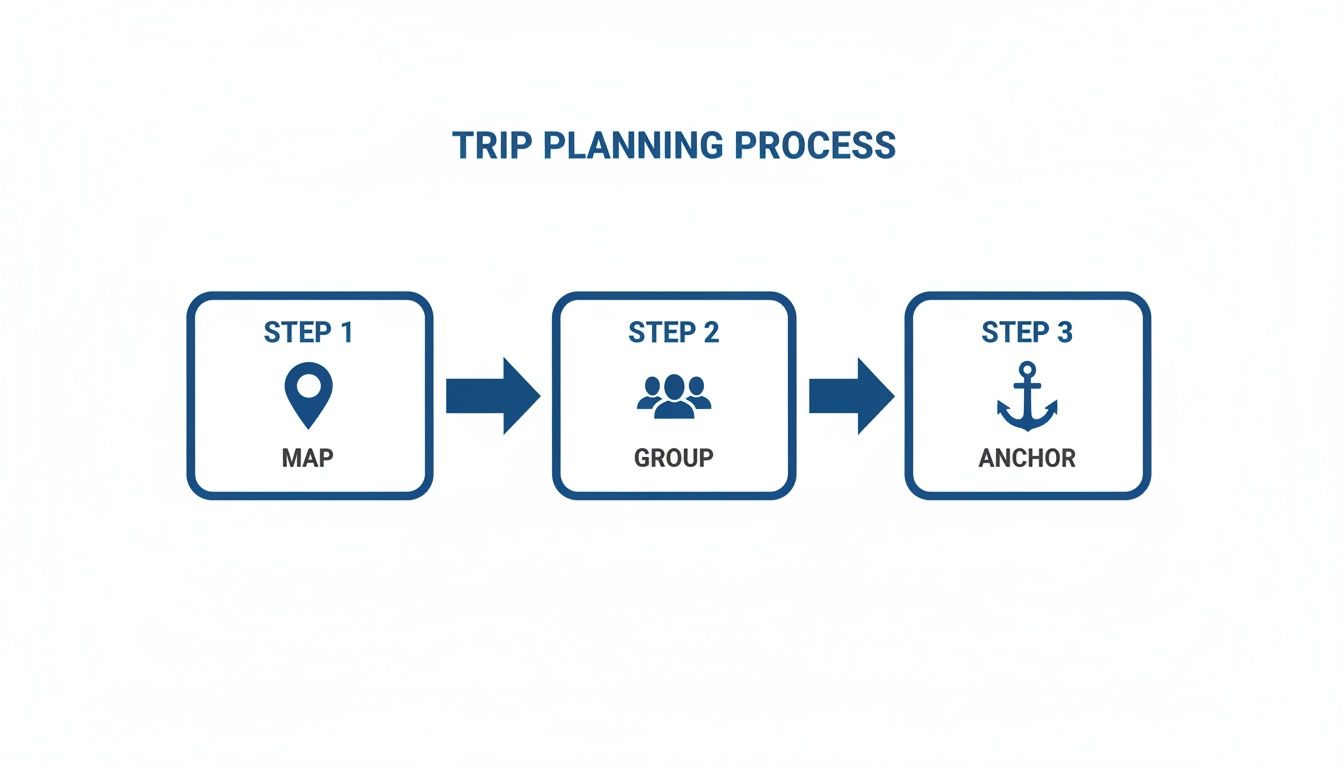
This flow—map, group, anchor—is your best defense against the frantic travel that leaves you needing a vacation from your vacation.
Timing Tip: A Simple Template for Your Day
Here’s how to think about your day to manage energy and sidestep the biggest crowds.
-
Morning (8 AM – 12 PM): This is your primetime for high-priority, high-traffic attractions. Get there early. Beat the tour buses. By the time the crowds peak, you’re already leaving.
-
Afternoon (12 PM – 5 PM): I call this the "Linger Zone." Don't rush to the next big thing. Find a spot for a long lunch. Explore the neighborhood you're already in—wander through local shops or relax in a park. This downtime is essential.
-
Evening (5 PM onwards): Reserve your evenings for dinner and low-key activities. This could be a scenic walk, finding a local bar, or catching a performance. The goal is to wind down, not cram in another major sight.
This strategic approach is getting easier to execute. Over 50% of travel firms now use AI for booking, and 49% rely on it for suggesting activities. These tools can analyze crowd patterns and recommend early-morning visits that have been shown to cut wait times by as much as 45%.
Of course, building this from scratch is a chore. This is the kind of decision fatigue that inspired us to create our own travel itinerary generator to handle the heavy lifting.
The WanderAssist Reality Check
<iframe width="100%" style="aspect-ratio: 16 / 9;" src="https://www.youtube.com/embed/hebapO0y0zI" frameborder="0" allow="autoplay; encrypted-media" allowfullscreen></iframe>Let's be direct. Most travel blogs are designed to funnel you into crowded, overpriced tourist traps. A great day-by-day plan is about sidestepping the disappointment of a bad experience.
Think about it: what if you skipped the two-hour queue for a generic photo and instead discovered a quiet nearby street with interesting architecture and zero crowds? That’s the kind of trade-off that makes a trip memorable.
Last time I was in Barcelona, I skipped the midday chaos at Park Güell. Instead, I spent my afternoon in the Gràcia neighborhood, stumbled upon a great little cafe, and actually felt the rhythm of the city. You don't get that connection when you're elbow-to-elbow with thousands of other people.
Price Warning: The Tourist Tax Is Real
One of the biggest pitfalls is the invisible "tourist tax." The cost of a simple coffee can jump by 20% or more just one block away from a major attraction. It's a calculated move that preys on tired travelers.
First-time city explorers often face 20-30% higher disappointment from peak commercial pressure and inflated prices. Optimized planners that provide honest timing tips and neighborhood context can cut these overcharge risks by up to 25%.
A plan built on reality is your best defense. By anchoring your day in a specific neighborhood, you’re more likely to find the local spots where prices are fair and the vibe is genuine. It's about being intentional so you can connect with a city, not just consume it. We dive deep into building smarter travel plans in our guide to using an AI travel itinerary.
How Do I Create This Plan Without All the Work?
Let's be honest. The manual research—figuring out which neighborhoods make sense, guessing crowd patterns, and calculating transit times for your day-by-day trip planner—is exhausting. It's the part of planning that turns excitement into a chore. I've lost countless hours cross-referencing maps and blogs, trying to piece together the perfect schedule, only to feel drained before I even packed.
This is where smart technology makes a difference. Instead of losing your weekend to research, you can get a structured itinerary that feels like it was made by a skeptical local. The key is to find a tool built on the same principles: anchoring your day, timing your visits wisely, and setting realistic expectations.

Generate a Smart Plan in 60 Seconds
The whole point is to get rid of that manual grind. That’s why we built the WanderAssist 60-second planner. It takes this entire reality-aware framework and automates it, so you get a solid plan without the headache.
The process is simple:
- Plug in Your Destination: Tell it where you're headed.
- Set Your Travel Style: Are you looking for a relaxed pace, or trying to see as much as possible?
- Get Your Plan: In about a minute, you get a time-blocked, day-by-day itinerary that logically groups activities by neighborhood and gives you smart timing suggestions.
When you automate this, you reclaim hours of your life. You skip the tedious research and jump straight to a usable plan that’s designed to prevent burnout and tourist-trap fatigue. That frees you up to do the important part: actually look forward to your trip.
FAQs for Your Day-By-Day Trip Plan
Even with a good system, a few questions always come up. Remember, the goal isn't a rigid, minute-by-minute schedule. It's about building a smart, flexible framework that can handle the chaos of actual travel.
How Much Buffer Time Should I Actually Add?
As a rule, I add a 25% time buffer to anything with travel time. If Google Maps says it’s a 20-minute subway ride, I block out 25 minutes. That little cushion covers things like figuring out the ticket machine or a train running late without sending you into a panic. For a full day, I also build in at least one totally free two-hour block.
What Happens When My Plan Inevitably Falls Apart?
Because it will. A cathedral might suddenly close or a rainstorm ruins your park plans. Don't sweat it. Since you've anchored your day in a specific neighborhood, you've got an advantage. You aren't starting from scratch; you're just shifting focus within that same small area.
The best way to handle a derailed plan is to have a simple backup for each neighborhood. Think "find a cafe in Le Marais" or "browse the local market near the Vatican."
This lets you pivot gracefully instead of frantically replanning your trip on a street corner.
Is It Really Okay to Schedule "Do Nothing" Time?
Not only is it okay, it’s essential. A packed schedule doesn't equal a good trip. Burnout is real, even on vacation. A great itinerary includes intentional downtime. Give yourself permission to just sit in a park, linger over a coffee, or wander down an interesting street with no destination. If your day-by-day trip planner doesn't have at least one of these "linger zones" each day, you're missing out.
Tired of the planning grind? The WanderAssist 60-second planner builds you a reality-aware itinerary using these exact principles, freeing you up to actually enjoy your trip. Give it a try at WanderAssist.com.