
What's New Orleans Weather in February *Really* Like?

Planning a trip? Get the brutally honest guide to New Orleans weather February brings, including Mardi Gras realities and what you actually need to pack.
Here's the truth about New Orleans weather in February: it's a complete gamble. One day you'll get a perfect, sunny preview of spring, and the next could bring a damp, bone-chilling cold that cuts right through your jacket. Planning for this wild variability is the only way you're going to have a good time, especially if Mardi Gras is in full swing.
What should I actually expect from the weather?
Forget the generic advice. February in New Orleans is defined by its unpredictability, a trait that fuels the chaotic energy Mardi Gras thrives on. The city is caught in a meteorological tug-of-war between the last of winter's damp chill and the first hints of spring warmth. This means you need to be ready for just about anything short of a blizzard. I remember one trip where I was sweating in a t-shirt at noon and then desperately buying a beanie from a street vendor that same night.
Do the numbers match the feeling on the street?
On paper, the weather seems pretty tame. The average daytime temperature hangs around a pleasant 65°F (18°C), with nights cooling down to about 52°F (11°C).
But averages are a trap. They don't tell you about the real swings.
History shows a much wider, more dramatic range. Records reveal a staggering gap, from a summer-like high of 85°F to an extreme low of just 6°F, which happened way back on February 13, 1899. You can dive deeper into historical data about New Orleans weather on ExtremeWeatherWatch.com.
This graphic breaks down the typical daily temperatures and the historical extremes you should be aware of.
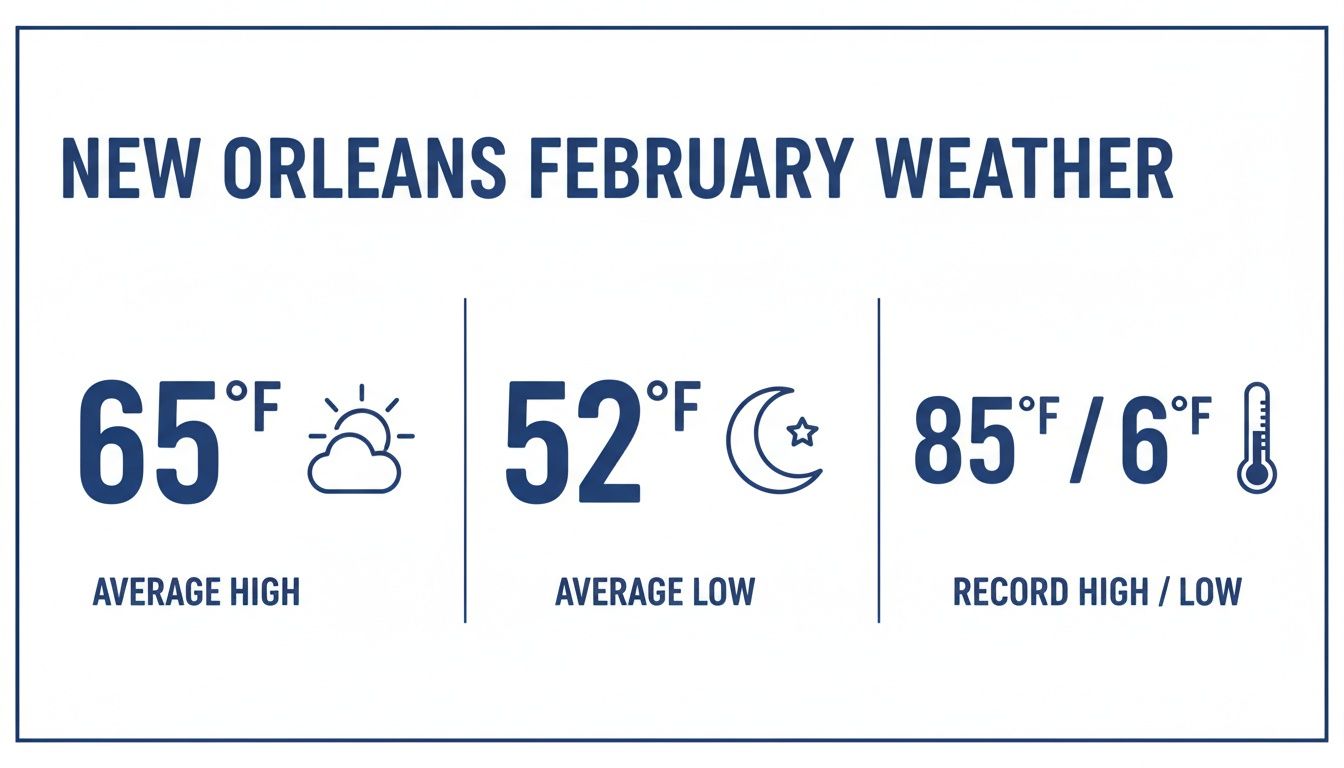
The key takeaway is that averages are just a guide; the extremes show what’s truly possible. That 65°F average feels fantastic in the sun but drops fast when clouds roll in or a breeze picks up off the Mississippi River. Planning for this kind of shoulder-season swing is just smart. For another perspective on spring travel, check out our guide on what to expect from Paris weather in May.
New Orleans February Weather Snapshot
Here's a quick look at the typical numbers, but pay attention to the "reality check" column—that's the part that actually matters.
| Weather Metric | Average | The Reality Check |
|---|---|---|
| High Temperature | 65°F (18°C) | Days can feel much warmer in direct sun or much colder on cloudy, windy days. |
| Low Temperature | 52°F (11°C) | That damp chill can feel colder than the number suggests, especially at night. |
| Rainy Days | ~8 days | Expect short, intense showers rather than all-day drizzle. |
| Sunshine Hours | ~6 hours/day | A mixed bag. You'll likely get a blend of sunny and overcast days. |
| Humidity | ~75% | Noticeably humid, but not the oppressive stickiness of summer. |
At the end of the day, the only real strategy is to pack layers and check the forecast every morning. That's how you handle New Orleans in February without getting caught out.
How bad is the rain in February?

Let's talk about the rain, because a sudden downpour can torpedo your French Quarter plans if you aren't ready. February isn’t the city's wettest month, but the rain here has a personality—it often arrives with a dramatic, all-or-nothing intensity that can leave you soaked in minutes.
Thinking about New Orleans weather in February means preparing for these short, intense bursts. On paper, the numbers look pretty tame. The city averages just about 5 rainy days for the whole month, totaling around 2.26 inches (57.4mm). But when it rains, it can really pour. The historical daily record is a staggering 6.5 inches. You can dig into more of the city's historical weather patterns over at TravelScoop.co.uk.
This isn't your average drizzle. I'm talking about the kind of deluge that quickly overwhelms the city's old drainage system. Last time I was there in February, I got caught in what felt like a flash flood near Jackson Square. The gutters became instant rivers, turning a pleasant walk into a frantic dash for cover.
Do I need an indoor backup plan?
Yes, absolutely. A flexible itinerary is your best friend. A rainy day doesn't have to be a wasted day, but you need a 'Plan B' that doesn’t involve huddling under an awning on Bourbon Street.
When the sky opens up, it's the perfect excuse to dive into the city's culture away from the main tourist trail. Here are a few solid alternatives that will keep you dry:
- Explore Southern Art: Instead of another t-shirt shop, spend an afternoon at the Ogden Museum of Southern Art. It’s a quiet, expansive space that offers a completely different perspective on the region.
- Find a Cozy Bywater Bar: Duck into a neighborhood spot like Bacchanal Fine Wine & Spirits (their covered patio is a lifesaver). You'll find good music, better conversation, and a real taste of local life.
- Catch a Matinee: The Prytania Theatre, a historic single-screen cinema Uptown, is a fantastic escape. It feels like stepping back in time and is a much better way to spend a rainy afternoon than staring at your hotel room ceiling.
My rule for February trips is to always have one or two indoor activities scouted out in a different neighborhood from where I'm staying. That way, a downpour becomes an opportunity to explore, not just a frustrating delay. It’s how you turn bad weather into a good story. Trying to figure this out on the fly while you're getting soaked is just a recipe for a bad time. If you're feeling bogged down by this kind of planning, the WanderAssist 60-second planner can help you build these flexible options right into your schedule.
How should I pack for this weather?
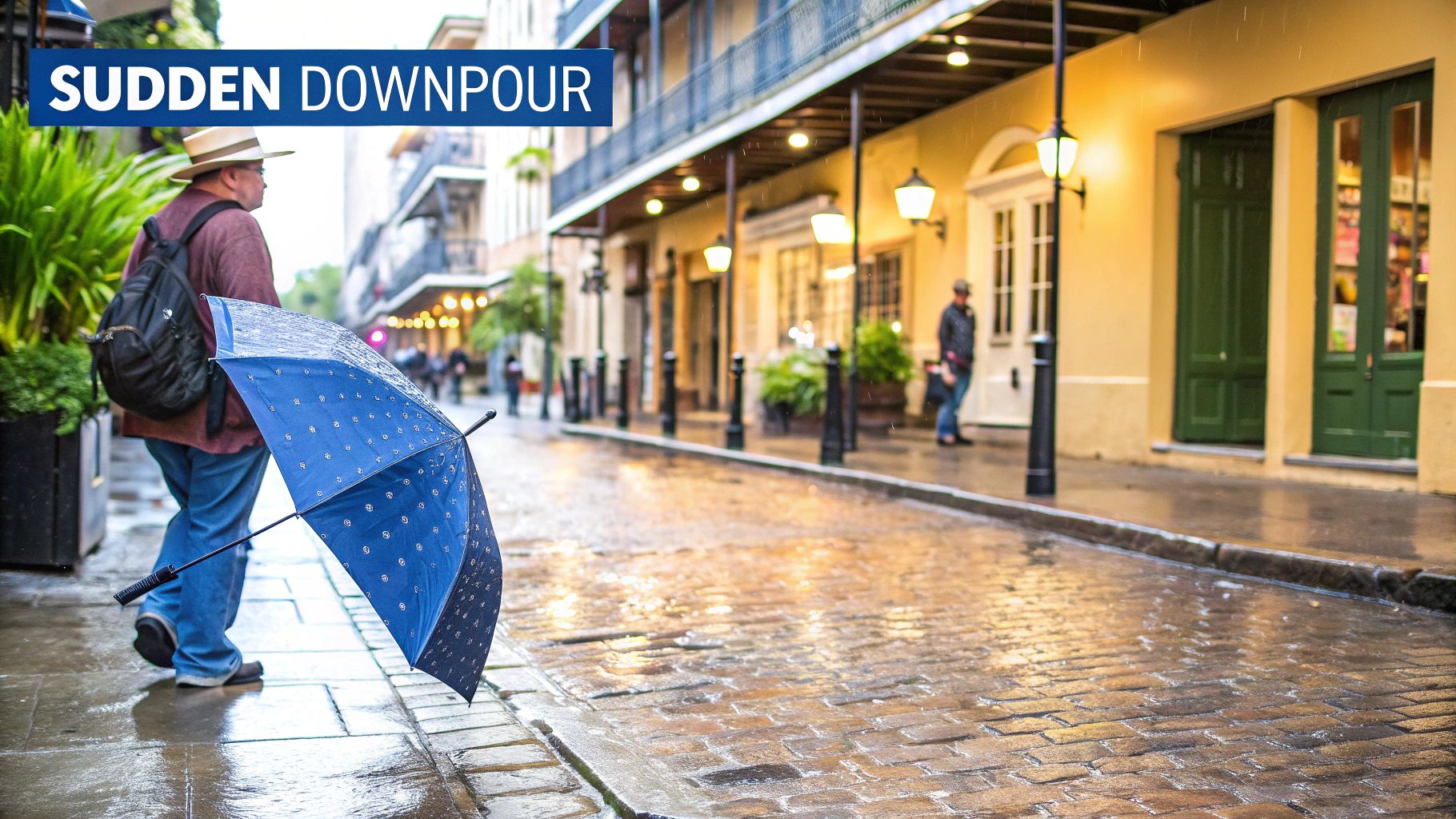
Packing for New Orleans in February requires a strategy, not just a suitcase thrown together at the last minute. One afternoon can feel like spring, only to have the evening bring a damp chill that seeps right into your bones. Let's ditch the generic "pack layers" advice and get specific.
This isn't about bringing your entire wardrobe. It's about choosing the right pieces that can handle a 70°F (21°C) sunny afternoon exploring the Garden District and a damp 45°F (7°C) night waiting for a parade. Trust me, the wrong outfit can ruin an evening.
Why is layering so important here?
The secret to staying comfortable is a simple three-part layering system. Think of it as your personal climate control.
Start with a base layer (like a cotton t-shirt), add a mid-layer for warmth (a sweater or fleece), and top it off with a waterproof shell for protection from wind and rain.
This approach means you're prepared for anything. You can peel off layers when the sun is out and quickly add them back as the evening cools or a sudden shower rolls in. It's all about being adaptable.
I once made the rookie mistake of thinking a stylish but flimsy pair of shoes would be fine for a "short walk" in the French Quarter. Hours and several blister-inducing blocks later, I learned my lesson. Your feet will thank you for prioritizing comfort over looks here.
The Essential February Packing Checklist
Deciding what makes the cut can be tricky. This table breaks down the must-haves versus the items you can confidently leave at home.
| Item Category | Pack This (And Why) | Leave at Home |
|---|---|---|
| Outerwear | A waterproof windbreaker. It's your best friend against rain and wind. A packable fleece or light down jacket is perfect for layering underneath. | Your heavy winter parka. It’s total overkill and you'll hate carrying it around when the sun comes out. |
| Footwear | Comfortable, broken-in walking shoes. The charming but uneven sidewalks are unforgiving. A second pair of comfy boots or loafers is great for dinners. | Brand-new shoes or flimsy sandals. You'll regret both after a few hours of walking. This isn't the trip to break in new footwear. |
| Tops | A mix of short- and long-sleeve shirts. This gives you flexibility to adjust your layers as the temperature swings throughout the day. | An entire suitcase of t-shirts. You'll need more substantial options for the cooler evenings, so focus on a versatile mix. |
| Bottoms | Jeans or comfortable travel pants. They are versatile enough for almost any activity, from walking tours to a casual dinner. | Formal dress slacks or skirts. Unless you have a very specific fancy event planned, you can probably skip these. |
| Accessories | A small, foldable umbrella and a scarf. The umbrella is non-negotiable for surprise showers. A scarf adds a surprising amount of warmth. | Heavy wool hats and gloves. While it can get chilly, it rarely gets that cold. A simple scarf is usually enough. |
Ultimately, while most of your time will be spent dressing casually (especially during Mardi Gras), it's always smart to pack one nicer, versatile outfit. New Orleans has an incredible food scene, and you'll feel right at home in a smart shirt or a simple dress at one of the city's acclaimed restaurants.
If you need more general ideas, we have a comprehensive list for packing for a trip that covers all the bases.
How do I plan my days around weather and Mardi Gras crowds?

If you're visiting in February, your trip will almost certainly overlap with Mardi Gras. The weather forecast then becomes just one piece of a much bigger, chaotic puzzle. The key to a good trip isn't a rigid itinerary; it’s knowing when and where to be to avoid the logistical gridlock that can swallow the city whole.
The number one mistake I see visitors make is trying to cram too much in. They’ll book a French Quarter brunch, a Garden District tour, and try to catch an Uptown parade all in the same afternoon. What they don't realize is that parade routes act like giant walls, literally slicing the city in two. You'll end up spending your entire day stuck.
Is there a smarter way to explore during Carnival?
A much better approach is neighborhood anchoring. Pick one or two adjacent, walkable areas for the day and stick to them. It's a simple change, but it cuts down on travel fatigue and frustration, letting you soak in the city's energy instead of fighting your way through it.
Think of it like this: during Carnival, New Orleans runs on two timelines—"Before Parades" and "After Parades." Your goal is to get all your exploring done in the "before" window.
Here’s a simple rhythm that works:
- Morning (8 AM - 11 AM): This is your golden hour. Pick a neighborhood far from that day's main parade route and explore. If the big parades are rolling Uptown, this is your chance to see the Marigny or Bywater. Grab a coffee and walk through Crescent Park.
- Midday (11 AM - 4 PM): Time to retreat. As streets close and the crowds swell, you have a choice: dive into the madness or escape it. This is a perfect time for a long lunch, a museum visit, or even a nap. Trying to cross town now is a recipe for disaster.
- Evening (Post-Parades): Re-emerge and explore. Once the last float has passed, the city grid starts to open back up. This is your chance to grab dinner or catch some live music in a spot that was impossible to reach a few hours earlier.
A Sample Daily Rhythm for a Parade Day
Let's put this into practice. Say a major parade is scheduled to roll down St. Charles Avenue in the afternoon.
A classic tourist mistake is thinking you can just "pop over" to the French Quarter from an Uptown parade spot right after it ends. You can't. Streets are barricaded, ride-shares are nowhere to be found, and the streetcar will have stopped running hours before. You have to plan to be where you need to be well ahead of time, or just plan to stay put.
Here’s how you could build your day to avoid that trap:
- Morning: Kick things off in the Lower Garden District. Grab breakfast at a place like Molly's Rise and Shine, then wander through the quiet residential streets to admire the architecture. You're close to the action but not yet consumed by it.
- Late Morning: Start making your way towards the St. Charles Avenue parade route. Find a good spot, grab some drinks and snacks from a corner store, and settle in. The party starts building long before the first float appears.
- Afternoon: Enjoy the parade! This is your main event for the next few hours.
- Evening: After the last float passes, walk deeper into the Garden District or the Irish Channel for dinner. You'll find great neighborhood restaurants far from the massive crowds stumbling back toward the French Quarter.
This approach isn't about avoiding the fun—it's about being smart about it. If juggling these logistics feels overwhelming, you can learn more about how to plan a trip itinerary that builds this kind of flexibility in from the start.
The WanderAssist Reality Check
<iframe width="100%" style="aspect-ratio: 16 / 9;" src="https://www.youtube.com/embed/Z8bfrLpER-Q" frameborder="0" allow="autoplay; encrypted-media" allowfullscreen></iframe>Alright, let's have a real talk. The biggest shock you’ll experience in February isn't a surprise cold snap—it's the logistical and financial gut punch of Mardi Gras. The entire city rewires itself for Carnival. If you show up unprepared, you're going to spend way more money and have a lot less fun. Public transit, including those famous streetcars, gets rerouted or just shuts down for hours. Ride-share prices? They’ll surge to levels that will make your eyes water.
The Real Cost of Carnival
Let's not dance around the money issue. The idea of a "budget" Mardi Gras trip is a fantasy unless you're crashing on a friend's couch.
Price Warning: Hotel and flight prices don't just go up a little—they often double or even triple, especially over the big parade weekends leading up to Fat Tuesday. A hotel room that’s normally $150 can easily skyrocket to $450 during the final Carnival weekend.
This inflation seeps into everything. Restaurants along parade routes will have "special" menus that are limited and overpriced. Even a bottle of water from a street vendor will set you back $5. You absolutely have to budget for these costs, or the sticker shock will be brutal.
How do I sidestep the biggest tourist traps?
The most obvious trap is Bourbon Street during parade season. It essentially becomes a dense, sticky-floored holding pen for first-timers. You can do better.
- The Drink Trap: You'll see bars luring people in with giant, neon-colored souvenir cups. Take it from me: the drinks are usually weak, syrupy, and outrageously expensive. The pro move is to grab a 'go-cup' of beer or wine from any corner store and find a good spot to people-watch.
- Parade Route Etiquette: This is a crucial tip. Never pick up beads that have hit the ground. It’s a huge rookie mistake and the fastest way to get your fingers stomped on. The whole point is the thrill of the catch, and trust me, there will be plenty more coming.
- The "Exclusive" Balcony Pass: Paying hundreds for a spot on a Bourbon Street balcony sounds glamorous, but the reality is often being crammed shoulder-to-shoulder with a terrible view. For a fraction of that price, you can find a spot further Uptown on the St. Charles route, catch better throws, and have a much more authentic experience.
In the end, loving New Orleans in February is all about managing expectations. It's going to be crowded. It's going to be expensive. And it's going to be chaotic. But if you plan for the reality on the ground, you can navigate it like a local.
Answering Your Top Questions About Visiting in February
Let's get right to it. A February trip to New Orleans is a fantastic idea, but it comes with quirks, from parade chaos to weather that can't make up its mind. Here are some straight-up answers.
Is New Orleans safe during Mardi Gras?
It’s as safe as you make it. The city is bursting with people, and like any massive event, that means you need to be aware. The parade routes themselves are crawling with police and generally feel like a giant, communal party.
Most trouble finds people who are over-drinking or not paying attention. Keep your phone in your front pocket, stay with your friends, and know your limits. Frankly, the bigger risk isn't crime, but the logistical mess of a packed city. Stick to well-lit, busy streets, especially after dark.
Can I bring my kids to Mardi Gras?
Absolutely! But—and this is a big but—you have to be strategic. The drunken spectacle on Bourbon Street and in the dense parts of the French Quarter is not where you want your kids. It’s a recipe for a bad time.
Instead, the family-friendly Mardi Gras happens Uptown along the St. Charles Avenue parade route. This is where you'll find generations of local families with their ladders and coolers. The vibe is less "wild party" and more "epic neighborhood block party." Find a spot in the Garden District, bring snacks, and watch your kids' faces light up as they catch beads.
What happens if the weather is just awful?
A string of cold, rainy days doesn't have to be a bust. This is why you need a solid list of indoor plans that you're actually excited about. A dreary day is the perfect excuse to explore some of the city’s great museums.
Here are a few of my go-to rainy-day saviors:
- The National WWII Museum: You could lose an entire day in here. It's a powerful, immersive experience that's a must-do, rain or shine.
- The Sazerac House: Part museum, part distillery tour, this spot offers a dive into the history of New Orleans' official cocktail.
- The Shops of the Colonnade - French Market: While some of it is open-air, a large part of the historic French Market is covered. You can wander through stalls of local crafts and food, protected from the rain.
Don't think of your indoor activities as a disappointing backup plan. A rainy day spent getting lost in the WWII Museum followed by a long, cozy dinner at a classic Creole restaurant is an amazing New Orleans experience on its own.
Do I need to plan everything around parades?
Yes. A thousand times, yes. This is not optional. During the final stretch of Carnival, the city operates on a completely different set of rules. Major streets are shut down for hours, streetcars stop running, and getting a rideshare is difficult and expensive.
Thinking you can just "pop over" from the Garden District to the Marigny an hour before a parade is a rookie mistake that will leave you stranded. Check the parade schedule every single day. Plan on being where you need to be well before the barricades go up, or use the parade time to explore a neighborhood far from the route. Planning around the parades isn't just a good idea—it's a survival tactic.
Feeling overwhelmed by juggling weather, crowds, and street closures? The WanderAssist 60-second itinerary builder was made for this exact scenario. It crafts a flexible daily plan that puts you in the right neighborhood at the right time, helping you sidestep the chaos. Spend less time stressing and more time soaking it all in. Get your reality-aware travel plan at https://wanderassist.com.