
A Brutally Honest Guide to a Travel Itinerary Generator

Tired of generic advice? A travel itinerary generator can save you hours, but only if you use it right. Here’s a no-nonsense guide to planning a better trip.
A good travel itinerary generator doesn't just list popular spots; it creates a realistic, walkable schedule that helps you sidestep the worst crowds. The real value isn't in what you see, but in the when and how. This guide breaks down how these tools actually work and how to use them to build a trip that feels relaxed, not like a frantic race.
What's a travel itinerary generator, really?
Think of a smart itinerary generator as a GPS for your time, not just your location. Its job is to navigate you around the "traffic jams" of tourist hotspots. It's the difference between a frantic, box-checking sprint and a vacation that actually feels like one.
Last time I was in Rome, I made the classic mistake. I had a massive list of "must-sees" and tried to cram it all into three days. The result? I spent most of my time on jam-packed buses, waiting in line under a blazing sun, and feeling completely drained. That's exactly the kind of travel headache these newer, smarter generators are designed to cure.
So, is it more than just a list?
The travel industry is massive, with global market bookings projected to reach $1.67 trillion by 2026. All that growth means more choices, more travel blogs, and more pressure to plan the "perfect" trip. For anyone with a busy life, a tool that cuts through that noise is a lifesaver. You can discover more insights about these travel market trends if you're curious.
A top-tier generator offers a genuine strategy, not just a sequence of places. It does this by:
- Anchoring your day: It groups activities by neighborhood, so you aren't crisscrossing the city and wasting an hour on the metro to get from one sight to the next.
- Respecting reality: It knows that showing up at the Colosseum at 10 AM is a totally different (and much worse) experience than visiting in the late afternoon.
- Preventing burnout: It builds in downtime and avoids scheduling intense, back-to-back activities. It remembers you're a human, not a sightseeing robot.
A bad generator gives you a checklist; a good one gives you a rhythm. It helps you find the natural flow of a city, so you can spend less time fighting crowds and more time actually enjoying where you are.
At the end of the day, its purpose is to do the logistical heavy lifting for you. Instead of spending hours juggling Google Maps and museum opening times, you get a solid framework in seconds. This frees up your brainpower for the fun stuff, like figuring out where to find the best espresso. A tool like the WanderAssist 60-second planner is built for exactly this—solving the decision fatigue.
How do AI travel planners actually work?
It’s not magic—it’s just incredibly fast data analysis. An AI travel itinerary generator acts like a research assistant on steroids, sorting through museum hours, transit schedules, user reviews, and even real-time data on how busy a place is.
Think of it less like a simple search engine and more like a personal logistics expert for your trip. But here’s the key: not all of them work the same way.
Is there a difference between them?
Most simple generators are what I call 'List-Makers.' They grab a pre-made list of popular tourist spots and dump them into a schedule. The problem? They don't account for the real-world friction of travel, like the time it takes to get from Point A to Point B. This is how you end up zigzagging across a city, spending more time on a bus than you do sightseeing.
Then there are the more advanced tools, which I'd call 'Strategists.' These are the ones that actually think. A strategist AI, like WanderAssist, uses temporal reasoning and neighborhood anchoring. In plain English, it understands that when you visit a place is just as important as what you're visiting. For example, hitting the Louvre at 11 AM on a Saturday is a totally different (and much worse) experience than going at 6 PM on a Wednesday.
This graphic breaks down the core benefits of using a smarter, strategic approach.
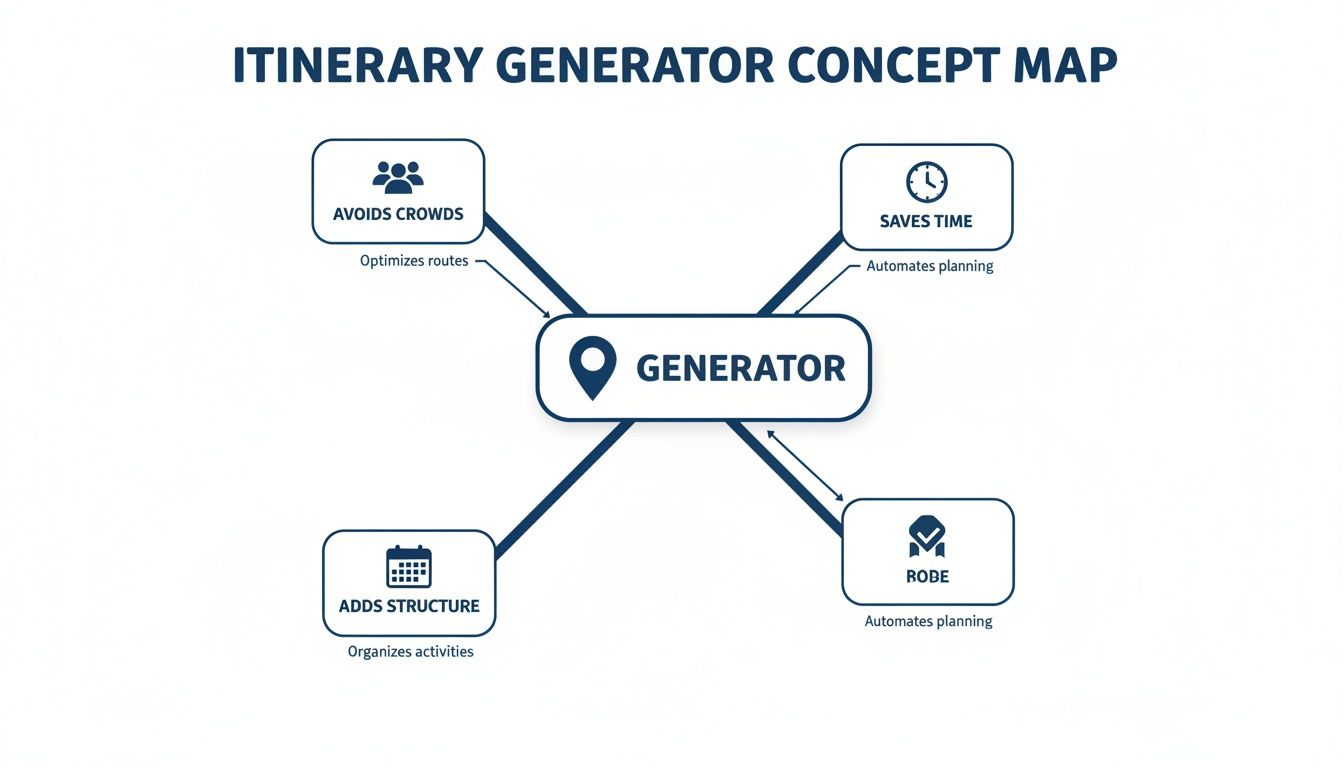
As you can see, it's all about building a smart structure that saves you time and cuts down on stress. A strategist AI also groups your activities into walkable clusters.
It won’t just tell you to see the Eiffel Tower and Notre Dame on the same day. It builds a plan where you explore the entire Latin Quarter logically, ending your evening near the tower when the crowds have thinned and the lights come on.
This simple shift minimizes travel fatigue and maximizes your time actually enjoying the city. You get to spend less time staring at a metro map and more time taking in the sounds and smells of a new neighborhood.
Here’s a quick comparison to make the difference crystal clear.
| Feature | Generic 'List-Maker' Generator | WanderAssist 'Strategist' Generator |
|---|---|---|
| Trip Logic | Lists popular spots without context. | Groups activities by neighborhood and considers travel time. |
| Scheduling | Ignores opening hours and crowd patterns. | Optimizes for the best time to visit (e.g., fewer crowds). |
| Pacing | Packs the day, often unrealistically. | Builds a relaxed, logical flow with built-in downtime. |
| Output Quality | A frantic, checklist-style itinerary. | A calm, efficient, and enjoyable travel plan. |
Ultimately, the goal is to get a plan that feels intuitive and respects your time and energy. You can dig deeper into how a smarter AI trip planner builds this kind of efficient schedule. The difference is a trip that feels intentional and relaxed, not like a race against the clock.
Will an AI plan a better trip than a human?
<iframe width="100%" style="aspect-ratio: 16 / 9;" src="https://www.youtube.com/embed/AFozUHO93tM" frameborder="0" allow="autoplay; encrypted-media" allowfullscreen></iframe>Let's get right to it. Can an AI actually plan a better trip than you can? The honest answer is: it depends. It depends entirely on the AI—and, frankly, on you.
A generic itinerary generator will spit out a soulless, cookie-cutter plan. It won’t be better than what you could pull together yourself. But a smart, reality-aware AI? It can absolutely run circles around an uninformed human planner.
Why? Because it can process more logistical data in seconds than a person could in weeks. It knows the best time to visit an attraction to avoid the worst crowds and understands the geographical realities rookie planners often miss. I once saw a friend’s self-made Paris plan that had him zig-zagging across the entire city three times in one day—a perfect recipe for exhaustion. An intelligent AI would have caught that immediately.
What's the real advantage of using AI?
The real magic of a smart AI planner comes down to efficiency and managing your expectations. These tools are built to save you from dozens of hours of mind-numbing research and prevent common, frustrating mistakes.
The biggest win is preventing burnout before you even leave. A good generator creates a logistically sound framework that gives you a solid foundation to build on. This is becoming a go-to strategy, especially as more people look to technology for travel advice. In fact, AI is changing how we plan trips so fast that over 60% of Gen Z and Millennials are now using it for inspiration.
The trend is clear. Nearly 60% of Gen Z took two or more holidays in 2023, and adoption is soaring in markets like China (81%) and India (71%). You can learn more about how AI is redefining global travel and see the numbers for yourself.
So, are humans still needed?
Let’s be real about the limitations. An AI can’t read your mind. It doesn't know you’ll be in a specific mood on Tuesday afternoon or that you’ll suddenly get a craving for gelato from that little shop you just walked past.
This is where you come in. The best way to travel is to treat the generated plan as your optimized starting point, not the final word.
Think of the AI as your expert logistics director. It handles the boring parts like scheduling and routing. Your job is to be the 'art director'—adding the personal touches, spontaneous detours, and moments of joy.
A truly great travel plan is a partnership. The AI provides the solid, efficient structure that prevents your trip from turning into a logistical nightmare. You provide the personal flair that makes it your trip. It’s not about one being better than the other; it’s about using the AI’s strengths to free you from the stress of planning.
You can see how an effective AI itinerary planner can build this kind of collaborative framework. The goal is simple: let the machine handle the logistics so you can focus on the experience.
How do you create an itinerary in 60 seconds?
Okay, that’s enough theory. Let's see how one of these tools can take you from a blank slate to a solid travel plan in less time than it takes to brew a coffee. This isn't just about spitting out a list; it's about building a smart, logical schedule that actually works on the ground.
The whole point is to cut through the overwhelming parts of trip planning. Instead of having twenty browser tabs open, you just give the tool a few key details and get a day-by-day plan back in seconds.
Step 1: Plug in your basic trip details
First, you need to tell the generator the essentials. Don't worry, this is the easy part.
- Your Destination: Where are you headed? (e.g., Paris, France)
- Trip Length: How many days are you staying? (e.g., 4 Days)
- Travel Style: What kind of pace are you after? (e.g., Relaxed, Moderate, or Packed)
These first few inputs give the AI the guardrails it needs to start building a sensible plan. For instance, picking a "Relaxed" pace tells the system you'd rather see fewer things well than rush through a dozen stops. It automatically builds in downtime, which is a lifesaver for avoiding travel burnout.
Step 2: Get your instant itinerary
Once you've entered those details, the generator gets to work. In less than a minute, it crunches all the data—museum opening hours, transit times, and geographical proximity—and produces a complete, time-blocked schedule.
Here's a look at what an initial plan from the WanderAssist 60-second planner might look like.

You can see it’s more than a simple list. The plan is laid out by day and time, with activities grouped together in a way that just makes sense, saving you from zig-zagging all over the city.
Step 3: Understand the "why" behind the plan
This is where a good itinerary generator shows its value. The plan it creates isn't random; it's strategic. Let's break down a hypothetical "Day 2" in Paris to understand the logic.
Example Paris Itinerary: Day 2
- Morning (9:00 AM): Explore the Marais district. Start at the Place des Vosges and meander through the historic streets. This neighborhood is best enjoyed in the morning before the chic boutiques get too crowded.
- Lunch (1:00 PM): Grab a falafel in the Jewish Quarter of the Marais. You're already there, so no extra travel time is wasted.
- Afternoon (3:00 PM): Walk to the nearby Pompidou Centre for modern art. This timing helps you miss the first wave of morning visitors.
- Evening (8:00 PM): Hop on the metro for a short ride to the Eiffel Tower. Why so late? Because the daytime queues are brutal. An evening visit means fewer crowds, and you get to see the tower sparkle.
This schedule is built on two simple but powerful principles: neighborhood anchoring (spending a chunk of your day in one walkable area) and temporal logic (visiting places at the best possible times). It’s an effective strategy that can save you hours of travel time and a ton of frustration.
The goal here is to give you a 90% solution—a strong, intelligent foundation you can build on. From this starting point, you can easily tweak the plan, swap activities, and leave room for those spontaneous moments, all while feeling confident that the core logistics of your trip are sorted.
The WanderAssist Reality Check
Let's be honest. A lot of online itinerary generators are little more than fancy search engines. They scrape the top 10 tourist spots, toss them into a list, and call it a day—often pushing you toward places that give them a kickback.
These tools rarely consider the actual friction of travel. They don't account for jet lag, the subway line that’s unexpectedly closed, or the simple reality that you can't be in three different corners of a massive city at once. The biggest tourist trap isn't a specific souvenir shop; it's the belief that you can "see it all." Chasing that impossible goal is the quickest way to turn a vacation into a frantic, box-checking marathon.
Price Warning: A Day in London
A poorly thought-out day doesn't just waste your time; it hits your wallet. When your plan is a fantasy, you're forced to make panicked, expensive decisions. You hail an overpriced cab because you're about to miss your timed entry. You pay a premium for a walk-up ticket because you didn't book ahead. A little forethought stops you from hemorrhaging money and energy.
| Expense | Reactive Tourist Price | Strategic Planner Price |
|---|---|---|
| Morning Transport | $25 (Panic Uber across town) | $7 (Efficient tube travel) |
| Attraction Ticket | $45 (Walk-up, peak-time price) | $35 (Pre-booked, off-peak slot) |
| Lunch | $30 (Closest tourist-trap cafe) | $15 (Local spot in the planned area) |
| Afternoon Coffee | $8 (Overpriced chain near landmark) | $4 (Independent cafe nearby) |
| Total Daily Cost | $108 | $61 |
As you can see, a single unplanned day can cost nearly double what it should. The point isn't to be chained to a schedule, but to have a smart framework that prevents these costly mistakes.
It's the constant, exhausting decision-making that really wears you down. If you're tired of that cycle, the WanderAssist 60-second planner is built to give you that smart structure instantly. It helps you shift your mindset from trying to 'do everything' to being able to 'enjoy anything'—calmly, and without blowing your budget.
How do you make the itinerary your own?

It’s best to view a generated itinerary as an expert-built foundation, not a rigid set of rules. Think of it as getting you 90% of the way there—it’s a solid, logical framework that handles all the heavy lifting of logistics and timing. Your job is to add that final 10% that makes the trip truly yours.
The whole point of a good itinerary generator is to take the stress out of planning. It frees up your mental energy so you can actually be present and spot those unexpected opportunities that end up being the best parts of any trip.
Last time I was in Lisbon, the AI-generated plan was perfectly structured. But one evening, I stumbled upon a tiny, unmarked Fado bar and was so captivated I stayed for hours. Because the plan had already handled the logistics, I had the freedom to be spontaneous without worrying it would derail the next day.
Your Personalization Checklist
Before you start booking, run the generated plan through a quick reality check. This is about layering your own travel style on top of the framework it built.
- Does this pace feel right? Are you a "get up and go" type, or do you need a slow morning with a coffee? Tweak the start times to match your natural rhythm.
- Where are the 'Linger Zones'? Pinpoint neighborhoods—like the Marais in Paris or Trastevere in Rome—where you can just wander without a specific destination.
- What's your 'Swap-Out' plan? What happens if it rains? Know which indoor activity you can easily swap for that planned park visit without wrecking the day's flow.
- Have you left room for discovery? The best travel memories are almost always unscripted. A solid plan should give you the confidence to ditch a scheduled stop when something more interesting pops up. For more ideas on this, check out our guide to creating a personalized travel itinerary.
Got Questions? We've Got Answers
You're probably thinking, "This sounds good, but what's the catch?" It's smart to be skeptical. Let's tackle a few of the most common questions people have.
Are these itinerary generators actually free?
Many of them are, at least for building your itinerary. Take WanderAssist, for example. You can generate a full plan in under 60 seconds, and you don't even need to sign up. It’s perfect for getting a solid first draft of your trip with zero strings attached. You might see some platforms offer paid upgrades for extras, but for building that core, optimized schedule? A good free generator gives you everything you need.
Can I really trust an AI's recommendations?
Here’s the deal: you can trust the AI to be a brilliant strategist, but you should always be the final editor. Think of the AI as your logistics expert. It excels at piecing the puzzle together—grouping nearby attractions and figuring out the best order to visit them. That said, when it suggests a specific restaurant or a tour, it's always a good idea to quickly check recent reviews yourself. The AI provides the framework; you add the final human touch.
How is this any different from using Google Maps?
That's a great question. Google Maps is a phenomenal navigation tool—it's the best at getting you from point A to point B right now. But that's where its function stops. An itinerary generator does the thinking that Google Maps doesn't. It builds a complete, time-managed schedule from scratch. It juggles opening hours, estimates how long you'll spend at each spot, and sequences everything in an order that makes sense.
Tired of the pre-trip planning headache? Let WanderAssist do the heavy lifting and map out a smart, efficient itinerary for you in less than a minute. Try the free planner now and get your time back.