
Your Ultimate Guide to an AI Travel Planner

Discover how an AI travel planner transforms trip planning. Learn how these tools work, their key benefits, and how to create the perfect itinerary in minutes.
Think of an AI travel planner as a smart assistant that builds a custom, day-by-day travel plan just for you. Instead of you spending hours on research, it takes your destination, interests, and preferred pace and, in moments, creates a logical itinerary packed with suggestions and optimized routes.
Reclaim Your Time from Travel Planning Overload
Remember planning your last big trip? It probably started with a spark of excitement that quickly got buried under an avalanche of open browser tabs, contradictory blog posts, and messy spreadsheets. You spent hours, maybe even days, piecing together attractions, checking opening times, and trying to map out a sensible route, only to realize your "perfect" plan had you crisscrossing the city like a pinball.
This whole ordeal is a classic case of decision fatigue. The manual process is like being handed a 1,000-piece puzzle without the box lid for reference. You know a beautiful picture is in there somewhere, but figuring out how the pieces fit together is a frustrating, time-consuming nightmare. You end up spending more time on the maddening logistics than on actually looking forward to the trip.
The Modern Solution to an Old Problem
An AI travel planner is the expert who walks in, looks at all those puzzle pieces, and assembles them perfectly in seconds. You just tell it what you want the final picture to look like—your destination, your interests, what a "perfect day" feels like to you—and the AI handles the rest.
This is exactly what a tool like WanderAssist is built for. It cuts through the chaos of traditional trip planning to give you a clean, logical, day-by-day schedule you can actually follow. The benefits are immediate:
- Save Serious Time: What used to take a whole weekend now takes less than a minute.
- Skip the Stress: No more guesswork or second-guessing every decision.
- Smarter Logistics: Your plan groups activities by location, so you're not wasting hours backtracking across town.
- Truly Personal: Get an itinerary that actually fits you, whether you're into ancient history, street food tours, or finding those quiet, hidden spots.
An AI planner shifts travel planning from a chore back to what it should be: a source of inspiration. It does the heavy lifting—the organizing, the mapping, the scheduling—so you can focus on the fun part: the anticipation of the journey. It's about building a practical, enjoyable experience from the ground up.
At the end of the day, this approach lets you walk into your vacation feeling prepared, not frazzled. You get a complete plan that feels like it was put together by a local expert who just gets you, setting you up for a much smarter and more enjoyable way to see the world.
How Does an AI Travel Planner Actually Work?
It can feel a bit like magic at first. You type in a few ideas about your dream trip, and seconds later, a full, day-by-day itinerary pops up on your screen. But what’s happening behind the scenes isn't sorcery—it’s a smart, logical process designed to think like an expert travel agent, just at lightning speed.
I like to compare it to getting a bespoke suit made. You wouldn't just grab one off the rack and hope for the best. A master tailor takes your measurements, asks about your personal style, and learns what the suit is for. That initial consultation is everything.
The massive growth in this space shows just how many people are tired of the old way of planning. The global AI in tourism market was valued at a huge USD 3.37 billion in 2024 and is on track to hit USD 13.87 billion by 2030. It’s clear that travelers are ready for a smarter approach.
The Inputs: Telling the AI What You Want
Everything starts with you—your travel DNA, so to speak. A great AI travel planner needs your specific "measurements" to build an itinerary that actually fits you. Don't worry, this isn't about filling out endless forms. It's about giving the system the essential building blocks for your trip.
Typically, you'll provide a few key details:
- Your Destination: The city, country, or region you’re heading to.
- Trip Duration: Exactly how many days you have to explore.
- Your Interests: What gets you excited? Think art, food, history, hiking, or just relaxing on a beach.
- Travel Pace: Are you a "see-it-all" whirlwind or someone who prefers to linger and soak it all in?
This infographic really captures how an AI planner takes the jumbled mess of travel research and turns it into a clear, stress-free plan.
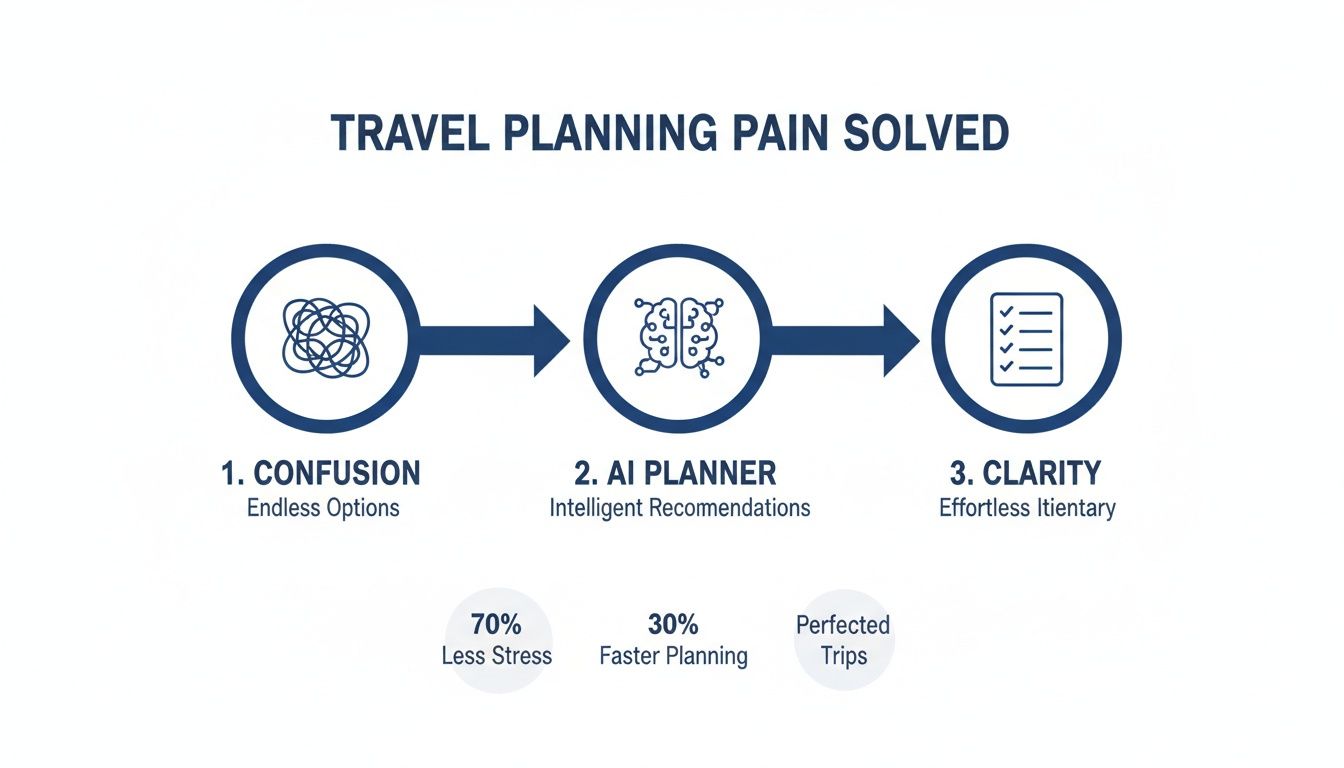
You can see the journey from tangled chaos to a beautifully organized schedule—that’s the whole point of these tools.
The AI's Brain: The Sophisticated Processing Engine
Once you’ve shared your preferences, the AI's engine kicks into gear. This is the moment the tailor takes your measurements and consults a lifetime's worth of knowledge about fabrics, patterns, and cutting techniques. For an AI, that "knowledge" is a massive, ever-growing collection of real-world travel data.
The AI instantly cross-references information from thousands of sources, including:
- Mapping Services: To calculate realistic travel times between spots, whether you're walking, taking the bus, or grabbing a cab.
- Attraction Databases: To get the nitty-gritty details right, like opening hours, ticket prices, and how long a visit usually takes.
- User Reviews and Ratings: To figure out which places people genuinely love (and which to avoid).
- Transit Schedules: To build in logical public transport routes.
The real genius of an AI travel planner isn't just in what it suggests, but in how it pieces everything together. It’s a logistics expert, not just a list-maker, and it builds a plan that actually works in the real world.
It doesn't just throw a bunch of popular museums at you. It checks that they're open when you're there, groups them by neighborhood to stop you from zigzagging across town, and gives you enough time to actually enjoy each one. That’s the difference between a list of ideas and a truly usable plan. You can see this logic in action when you generate your own WanderAssist itinerary.
The Final Output: Your Custom-Fit Itinerary
Finally, you get the finished product—the perfectly fitted suit, or in this case, your personalized travel plan. After crunching all the numbers and optimizing the logistics, the AI delivers a clean, day-by-day schedule. A well-designed planner will even break each day down into intuitive blocks like Morning, Afternoon, and Evening.
This isn't just a checklist. It's a thoughtfully sequenced schedule that gives your days a natural flow. You’ll see a morning activity, a great lunch spot nearby, and an afternoon museum that makes perfect geographical sense—all balanced to fit the travel pace you asked for. It takes the constant mental load of "what's next?" off your shoulders so you can just focus on having an amazing time.
The Real Benefits of Planning Your Trip with AI
Knowing how an AI travel planner works is one thing, but seeing the real-world difference it makes is another entirely. So, let's move past the technical "how" and dig into the tangible "why." The advantages go far beyond just getting a quick list of ideas—they completely reshape the travel planning experience, turning it from a stressful chore into an exciting preview of your adventure.

This shift isn't just a prediction; it's already happening. In less than a year, reliance on old-school search engines for travel research plummeted from 51% to 36%. At the same time, the use of generative AI platforms shot up from 6% to 15%. This data shows a clear preference for dynamic AI tools over static web pages, a trend you can explore in these travel industry AI insights.
Dramatic Time Savings
The first and most obvious win is the sheer amount of time you get back. Planning a multi-day trip the old way can easily swallow 8-10 hours, often spread across weeks. It's a frustrating dance of juggling dozens of browser tabs, cross-referencing reviews, and trying to make sense of confusing public transport maps.
An AI travel planner crushes that entire process down to less than a minute. By handling all the logistical heavy lifting automatically, it frees you from the drudgery of research. This lets you spend your time on the fun part: refining and personalizing the near-perfect itinerary it builds for you.
Deep and Meaningful Personalization
Let's be honest, generic travel advice is everywhere. Any travel blog can give you a "Top 10 Sights in Rome," but that list doesn't know the first thing about you. It doesn't know you're a coffee aficionado who'd treasure a tiny, historic café far more than another crowded monument, or that you'd rather spend an afternoon in a quiet park than a bustling square.
This is where an AI planner truly shines.
- Scenario: You tell the AI you're fascinated by Renaissance art but also have a soft spot for quirky, independent bookstores.
- Traditional Plan: You'd probably get a list with the Uffizi Gallery and maybe a generic bookstore chain.
- AI-Powered Plan: The AI schedules your Uffizi visit for the morning, then cleverly suggests a highly-rated, historic bookstore just a few streets away for a quiet afternoon browse, followed by a nearby artisanal gelato shop it found.
It masterfully connects your unique interests to build a cohesive experience—one that feels like it was handcrafted just for you, not copied from a generic guide.
Logically Optimized Routes
Have you ever ended a day of sightseeing completely exhausted, only to realize you spent half of it crisscrossing the city on subways and buses? That’s a classic symptom of poor logistical planning. An AI planner, at its core, is a powerful logistics engine.
It doesn't just suggest places; it sequences them. It understands that visiting Attraction A, then C, then B wastes two hours in transit when visiting A, B, and then C is a seamless, walkable route. This optimization is the invisible thread that makes an AI-generated itinerary feel so smooth and effortless.
Imagine you're in Paris. A manual plan might have you bouncing from the Louvre in the morning to Sacré-Cœur in Montmartre for lunch, then all the way back across town to the Eiffel Tower. An AI would instantly group the Louvre with the nearby Tuileries Garden and Musée de l'Orangerie, saving you hours of wasted travel time.
The difference in efficiency is night and day. Just look at this breakdown:
Traditional Planning vs AI Travel Planner
Here’s a side-by-side look at how much more efficient AI-powered planning is compared to the old-fashioned manual approach. The hours saved are staggering.
| Planning Step | Traditional Method (Hours/Days) | AI Planner Method (Minutes) |
|---|---|---|
| Initial Research | 3-5 hours of browsing blogs and guides | 2-3 minutes of inputting preferences |
| Creating a Draft | 2-4 hours of compiling notes & lists | Instant generation of a full itinerary |
| Mapping & Logistics | 2-3 hours on maps to create efficient routes | Automatically optimized in the initial plan |
| Revisions & Tweaks | 1-2 hours of rearranging and re-planning | A few minutes to swap or adjust activities |
| Total Time Spent | 8-14+ Hours | Under 15 Minutes |
As the table shows, the time commitment drops from days or weeks of work to a few minutes of focused input.
Ultimately, all these benefits work together. By saving you time and optimizing your routes, an AI travel planner drastically cuts down on the stress of planning. You'll arrive at your destination with a smart, personalized, and efficient plan, ready to explore with total confidence.
Putting an AI Travel Planner to the Test
Theory is one thing, but seeing an AI travel planner in action is where it really clicks. So, let's move past the concepts and walk through a real-world example. We're going to map out a hypothetical 3-day trip to Paris to show you exactly how a tool like WanderAssist can take a few simple ideas and spin them into a smart, practical itinerary you could actually use tomorrow.
All we need to do is give the AI the basic ingredients for our trip:
- Destination: Paris, France
- Duration: 3 Days
- Pace: Moderate (a good balance of sightseeing and just soaking it all in)
- Interests: Art, food, and history
With just that little bit of information, the AI gets to work. It's not just going to spit out a generic list of tourist traps. Instead, it’s designed to analyze our preferences and build a logical plan that actually makes sense on the ground.
Let’s see what it comes up with for day one.
Day 1: A Masterclass in Smart Sequencing
Right away, the plan for Day 1 shows off the AI's knack for logistics. This isn't just a list of places; it's a schedule with a natural rhythm, broken down into manageable chunks of time.
Morning (9:00 AM - 1:00 PM): Art and Royal Gardens
- Louvre Museum (9:00 AM): The AI suggests starting your day at the world’s largest art museum. Kicking off early is a pro move to beat the worst of the crowds, and it even points you toward key wings like Denon for the Mona Lisa or Sully for ancient artifacts.
- Tuileries Garden (11:30 AM): After a few hours of art, a leisurely stroll through the beautiful gardens right outside the Louvre is the perfect way to decompress and enjoy the Parisian atmosphere.
See the logic? It groups two major attractions that are literally next to each other. This simple but brilliant pairing saves you a 30-minute trip across town later, maximizing your time and preventing that all-too-common travel burnout. It’s the kind of efficiency that’s easy to miss when you're planning by yourself.
Afternoon (1:00 PM - 5:00 PM): Island History and Gothic Grandeur
- Lunch on Île de la Cité (1:00 PM): A short, pleasant walk from the Tuileries brings you to the historic heart of Paris. The AI recommends finding a classic bistro here for lunch.
- Notre-Dame Cathedral (Exterior View) & Sainte-Chapelle (2:30 PM): After eating, you can explore the island, admire the ongoing restoration of Notre-Dame from the outside, and then pop into the nearby Sainte-Chapelle to see its jaw-dropping stained-glass windows.
- Shakespeare and Company (4:00 PM): To cap off the afternoon, it suggests a visit to the iconic English-language bookstore just across the river.
Once again, the geographical clustering is spot on. All the afternoon activities are within a 10-minute walk of each other. This creates a seamless, relaxed exploration of one of the city's most historic neighborhoods, a far cry from a frantic plan that has you zigzagging all over Paris.
The AI planner acts as your personal logistics expert, not just an idea generator. It understands that a great day of travel is all about flow, making sure you spend more time experiencing the city and less time just trying to get around it.
Evening (6:00 PM onwards): The Latin Quarter
- Explore the Latin Quarter: As evening sets in, the AI points you toward the charming, narrow streets of the Latin Quarter, famous for its lively buzz.
- Dinner at Le Procope (7:30 PM): To satisfy our interest in history and food, it recommends dinner at one of Paris's oldest cafés—a place frequented by figures like Voltaire and Benjamin Franklin.
The evening suggestion connects perfectly back to our original prompt, offering a culturally rich dining experience that brings the day to a satisfying close.
The Power of an Actionable Plan
This sample itinerary really highlights what makes a good AI travel planner so different. It gives you more than just a list of ideas; it delivers a structured, logistically sound plan that feels intuitive and is genuinely easy to follow.
- Balanced Pacing: The schedule is full but not overwhelming, perfectly matching our "moderate pace" request.
- Thematic Cohesion: Each part of the day is built around a specific neighborhood or theme, making it feel cohesive.
- Practicality: The whole plan is grounded in reality, considering walking times and how close things are to each other.
This is the kind of powerful, usable itinerary you should expect. You can see it for yourself and start building a smarter trip when you plan your next trip with WanderAssist. The result is a travel plan that lets you explore with confidence, knowing every detail has been thoughtfully arranged for an amazing experience.
How to Choose the Right AI Planner for You
<iframe width="100%" style="aspect-ratio: 16 / 9;" src="https://www.youtube.com/embed/FwOTs4UxQS4" frameborder="0" allow="autoplay; encrypted-media" allowfullscreen></iframe>With so many new tools popping up, picking the right AI travel planner can feel like a job in itself. The truth is, they aren't all built the same. Some just spit out a generic list of ideas, while others, like WanderAssist, craft the kind of structured, easy-to-follow plans that actually make your trip better. To find a tool that genuinely helps, you need to know which features separate the good from the great.
It's no surprise that travelers are catching on. As of 2026, a staggering 80% of travelers worldwide already use AI to help plan their trips. And 65% say they prefer brands that use AI to make their experience feel more personal. The shift is even more pronounced with younger generations—over 60% of Gen Z and Millennials now turn to AI for everything from initial inspiration to building out a full schedule. You can dive deeper into these numbers in this 2026 travel trends report.
Look for Structured Itineraries
This is the big one. The most important feature to look for is an AI that generates a structured, time-blocked itinerary. A simple bulleted list of sights isn't a plan; it’s a to-do list that leaves you to figure out all the logistics. A truly useful AI travel planner breaks your day into logical chunks like "Morning," "Afternoon," and "Evening."
Why does this structure matter so much? Because it accounts for how travel works in the real world:
- Travel Times: It figures out how long it takes to get from one spot to the next.
- Activity Duration: It allocates a realistic amount of time for each museum, park, or tour so you don't feel rushed.
- Logical Flow: It orders your day to prevent you from zigzagging across a city, saving you precious time and energy.
A time-blocked plan is what turns a list of ideas into a day you can actually live out, moment by moment.
Prioritize Deep Customization Options
Even the best AI-generated plan is just a starting point. You need to be in the driver's seat. A good trip should reflect your travel style, which means you need the power to tweak, adjust, and rearrange the suggestions.
Look for tools that make it easy to modify the itinerary. Essential features include:
- Swapping Activities: Not feeling that museum recommendation? You should be able to swap it for something else with a single click.
- Adjusting the Pace: Want to cram more in? A good tool will let you switch from a "relaxed" pace to a "packed" one instantly.
- Editing Times: Planning to sleep in? You should have the ability to push your start time back and watch the rest of the schedule adjust automatically.
Without these controls, you're stuck with a rigid plan that might not fit your mood or energy levels once you're on the ground.
Demand Data Accuracy and an Intuitive Design
Finally, none of this matters if the information is wrong or the tool is a pain to use. An AI travel planner is built on a foundation of two things: reliable data and a user-friendly interface.
A planner’s value comes from its ability to simplify, not complicate. It should pull from up-to-date, trusted sources for details like opening hours and locations, and present the final plan in a clean, easy-to-read format.
Before you commit, check these two things. Data accuracy is non-negotiable; it's what keeps you from showing up at a museum on the one day it's closed. An intuitive user interface means you can get your plan built, edited, and saved without having to watch a tutorial. The best planners, like WanderAssist, make the entire process feel completely effortless.
Your AI Travel Planner Questions Answered
Jumping into a new way of planning your trips is bound to bring up a few questions. It’s smart to be curious about how these tools work—especially when it comes to the accuracy of the recommendations, your ability to make changes, and, of course, your privacy.
We've gathered the most common questions travelers ask about AI planners. Here are the straightforward answers you need to start planning with total confidence.
How Accurate Is the Information?
This is probably the most important question, and for good reason. A travel plan is completely useless if it’s built on outdated or flat-out wrong information.
Top-tier AI planners solve this by pulling data from multiple, constantly updated sources. Think of it as getting a second, third, and fourth opinion in an instant. Instead of relying on a single travel blog that might be two years old, a good AI travel planner cross-references information from live databases. It checks Google Maps for current business hours, looks at real-time transit data, and confirms location details from verified sources. This multi-source approach often makes the information even more reliable than what you'd find digging around on your own.
Of course, no system is perfect. AI can sometimes make mistakes, a phenomenon known as "hallucination." While the best platforms are about 95% accurate, it's always smart to double-check mission-critical details yourself, like that can't-miss dinner reservation or specific tour times. The AI gives you a solid, logistically sound framework, saving you hours of grunt work and letting you focus on confirming the final, crucial details.
Can I Customize the AI Itinerary?
Absolutely. The best AI travel planners are designed to be a powerful starting point, not a rigid, unchangeable schedule. The goal here is collaboration, not dictation. The AI does the heavy lifting—organizing, sequencing, and optimizing—and then hands the reins over to you for the final, personal touches.
Great platforms give you several ways to make the plan your own:
- Swap Activities: Not a fan of a particular museum? You should be able to easily swap it for another attraction that’s more your style.
- Adjust Your Pace: Feeling like a whirlwind tour one day and a lazy stroll the next? A flexible tool lets you change the intensity from "packed" to "moderate" or "relaxed."
- Drag-and-Drop Editing: Having the freedom to easily move activities between different time slots or days gives you complete control over your trip's flow.
Think of the AI-generated plan as a perfectly prepped canvas. The composition, perspective, and major elements are already sketched out for you. Your job is to come in and add the colors and details that make the masterpiece uniquely yours.
This flexibility is what makes it work. It ensures the final itinerary isn't just efficient but is also a true reflection of your personal travel style.
Is My Personal Data Safe?
In an age where we're always connected, data privacy is a huge deal. Reputable AI travel planners get this and make your security a top priority. A tell-tale sign of a trustworthy service is one that provides incredible value without demanding your personal information right out of the gate.
For example, high-quality platforms like WanderAssist let you generate a complete, detailed itinerary without forcing you to create an account or hand over any personal info. The details you enter—your destination, interests, and preferred pace—are used only to build your travel plan. They aren't stored or linked back to you.
This approach lets you get the full benefit of the tool without compromising your privacy. That said, it's always smart to be informed. Before using any new service, take a moment to review its policies. You can learn more about how your data is handled by checking out our straightforward WanderAssist privacy policy.
How Is This Different from a General Chatbot?
This is a crucial distinction that really gets to the heart of what makes a dedicated AI travel planner so effective. Sure, you can ask a general-purpose chatbot like ChatGPT or Gemini for a list of "top things to do in Rome," but all you'll get back is just that—a list. It lacks the logistical intelligence to turn that list into a real, workable plan.
A general chatbot might suggest visiting the Colosseum, then the Vatican, then the Borghese Gallery all in one afternoon. On paper, it sounds exciting, but in reality, it's a logistical nightmare that completely ignores geography, travel times, and ticket availability.
A specialized AI travel planner is a different beast entirely because it’s built on a foundation of travel-specific data and logic. It’s a sophisticated logistics engine that thinks about things like:
- Geographic Proximity: It groups attractions by neighborhood so you aren't wasting hours backtracking across town.
- Opening and Closing Times: It makes sure you don't show up at a museum on the one day of the week it's closed.
- Realistic Travel Times: It calculates how long it actually takes to get from point A to point B, whether you're walking or hopping on the subway.
- Sensible Pacing: It allocates enough time to actually enjoy each stop without feeling like you're in a race.
In short, a general chatbot gives you a list of ingredients. A true AI travel planner gives you the full recipe, complete with step-by-step instructions. It transforms a scattered list of ideas into an actionable, day-by-day schedule you can actually follow from morning to night.
Ready to see the difference a truly intelligent plan can make? Stop juggling tabs and start exploring. With WanderAssist, you can create a personalized, optimized, and stress-free itinerary in under a minute.
Create Your Free Travel Plan with WanderAssist
Article created using Outrank