
Should You Visit New York in March? The Honest Answer

new york in march: discover weather patterns, crowd tips, and costs to plan a realistic trip with confidence and fewer surprises.
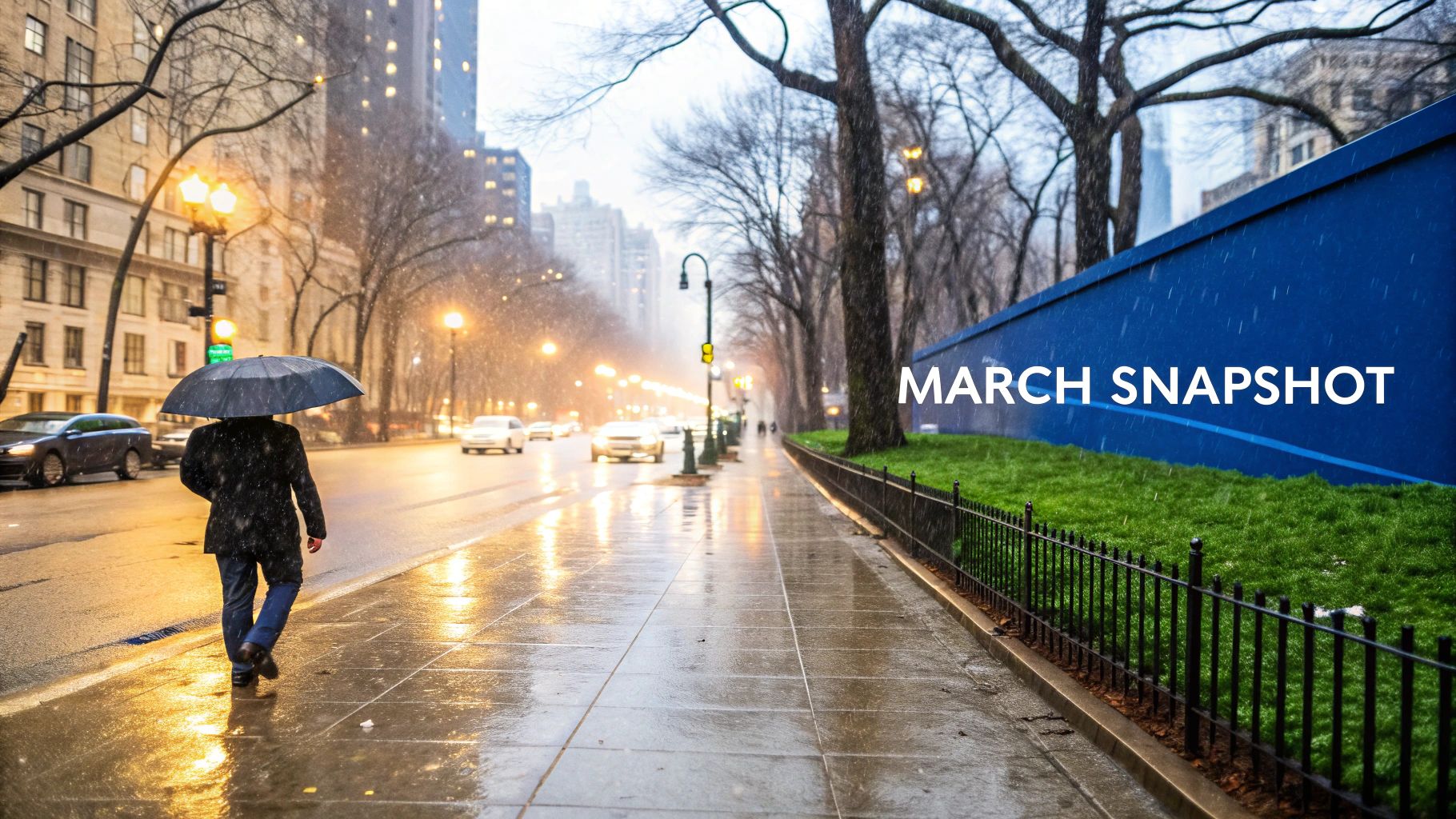
Visiting New York in March is a gamble, but it can pay off if you know what you’re getting into. The city is shaking off winter, but spring hasn't fully arrived. You might get a crisp, sunny day perfect for walking, followed by a sudden icy rain or even a final snow flurry. Plan for all three.
The main trade-off is clear: you’ll deal with unpredictable weather in exchange for slightly smaller crowds and lower prices than you'd find in peak season. Last March, I was enjoying a surprisingly warm afternoon in Central Park, and ten minutes later, I was huddled under an awning as a wet, freezing rain came down. That’s March in a nutshell.
Is March a Good Time to Visit NYC?
Yes, but only if you're the right kind of traveler. March is firmly in the "shoulder season," that in-between time after the deep freeze of winter but before the tourist rush of summer.
Let's break down what that really means for your trip.
NYC in March: Pros vs. Cons
| Pros (The Upside) | Cons (The Reality) |
|---|---|
| Fewer crowds at top attractions | Unpredictable weather (rain, snow, sun... all possible) |
| Cheaper flights and hotel rates | Not warm enough for outdoor dining or rooftop bars |
| A more local, less chaotic feel | Some outdoor events and attractions may still be closed |
| The city is buzzing with pre-spring energy | Can be gray and damp, requiring flexible indoor plans |
As you can see, you sacrifice predictable weather for better prices and a less hectic experience.
This isn't just a feeling; the numbers back it up. While New York saw around 62.2 million visitors in 2023, the crowds in March are noticeably thinner than in July or December. You’ll spend less time in line at the Empire State Building and more time actually enjoying the view.
The trick is having a flexible game plan. Know what you want to do, but have a solid list of indoor alternatives ready. Planning on the fly is exhausting. That decision fatigue is exactly why tools like the WanderAssist AI travel planner exist—it helps you build a smart, adaptable itinerary in minutes so you’re ready for whatever the city throws at you.
What Does March Weather Actually Feel Like in NYC?
Forget what your weather app says. The number on the screen doesn't capture the reality of New York in March. It’s less about the specific temperature and more about the damp, persistent chill that seems to find its way through every layer of clothing.
The city’s famous skyscrapers create wind tunnels that can turn a brisk day into a bone-chilling one. I remember one afternoon near Bryant Park; the sun was out, and I thought I was overdressed. Within minutes, the wind picked up, and the cold felt twice as intense. That’s what you need to prepare for.
How Should I Dress for the Unpredictable Climate?
The only winning strategy is layering. You have to be ready to add or shed clothes as you move from the windy streets into a warm subway car or a coffee shop. Think of your outfit as a modular system, not a single look.
One moment you’ll be grateful for your hat and gloves, and the next, a sudden sunny spell will have you wanting to strip down to a long-sleeve shirt. This isn’t an exaggeration; it’s just a typical March afternoon. The weather simply refuses to commit.
Your packing list needs to reflect this volatility. Being comfortable is the difference between a great trip and a miserable one.
What is the Non-Negotiable March Packing List?
Packing light is a noble goal, but for New York in March, packing smart is far more important. Bringing the right gear means you won’t waste money on emergency items you already own. Don't leave home without these:
- A Waterproof Outer Layer: A trench coat or light rain jacket is critical to block the wind and inevitable rain. Sleet is also a real possibility.
- A Packable Puffer Jacket: This is your core warmth layer. It’s light enough to stuff in a backpack when the sun appears but provides serious insulation when you need it.
- Waterproof Boots: This is absolutely non-negotiable. Sidewalks will have mystery puddles from melted snow or recent rain. Cold, wet feet will ruin your day faster than anything.
- Warm Hat, Gloves, and a Scarf: These small items make a huge difference, especially in the mornings and evenings when temperatures drop.
- Moisture-Wicking Base Layers: Think merino wool or synthetic fabrics, not cotton. They'll keep you dry and warm if you work up a sweat walking.
The WanderAssist Reality Check: The biggest mistake visitors make is underestimating the wind. A 38°F (3°C) day can easily feel like 25°F (-4°C) when you’re walking between tall buildings. Your packing should plan for the "feels like" temperature, not the official one.
Ultimately, you’re dressing for three seasons in one day. You might start the morning feeling like it's winter, experience a hint of spring by lunch, and face a chilly, damp evening that feels like late autumn. Embrace the chaos, pack in layers, and you'll be fine.
How Do I Balance Indoor and Outdoor Activities?
The secret to a good trip to New York in March isn’t cramming your schedule; it’s making your schedule smart. The city's fickle weather means you need a flexible plan that pairs your outdoor goals with indoor escapes. I call this strategy "neighborhood anchoring," and it's your best defense against wasted time and weather-induced misery.
Think of each day as a self-contained mission. Pick one neighborhood—say, the Financial District—and make your main goal an outdoor activity, like walking the Brooklyn Bridge. Then, scout two or three good indoor spots right there. If the wind gets nasty, you duck into the Fraunces Tavern Museum. If drizzle starts, you find a coffee shop on a cobblestone street.
This approach saves you from subway fatigue and frantic, on-the-spot decisions. You’re not zigzagging across Manhattan; you're actually experiencing one area, ready for whatever the sky does.
Why Is Neighborhood Anchoring the Best Strategy?
Planning your day around a single, walkable district is the most efficient way to see NYC when the weather is a toss-up. It means less time stuck on the subway and more time soaking in a neighborhood's energy.
Instead of a mad dash from Midtown to Lower Manhattan and back again, you can spend a morning wandering Greenwich Village, knowing you have a warm jazz club or the Whitney Museum as a backup plan. This simple method turns a potential weather disaster into a planned pivot.
- Minimize Transit Time: You’ll spend less time getting from A to B and more time enjoying the area.
- Stay Flexible: A sudden downpour is no longer a trip-ruiner. It’s just your cue to switch to the indoor activity you already had in mind.
- Reduce Decision Fatigue: With a pre-vetted list of options for one neighborhood, you won’t be scrolling through your phone in the cold, desperately trying to figure out what to do next. The WanderAssist 60-second planner is designed to solve exactly this problem.
How Can I Pair My Plans for Any Weather?
Let's put this into practice. The trick is to match an iconic outdoor experience with a compelling indoor backup in the exact same area. This creates a balanced day that works whether it's sunny, rainy, or snowing.
A classic example is pairing a walk across the Brooklyn Bridge with an afternoon exploring DUMBO.
- Timing Tip (The Outdoor Plan): Start on the Manhattan side of the Brooklyn Bridge and walk toward Brooklyn. Go early (before 9 AM) to beat the worst of the crowds and catch the morning light on the skyline. The crisp March air feels great.
- The Indoor Pivot (Late Morning/Afternoon): Once you’re in DUMBO, you’ll probably feel the chill. Your options are at your feet: grab a hot chocolate at Jacques Torres, browse the shops inside Empire Stores, or spend an hour at the New York Transit Museum just a short walk away.
You can apply this method all over the city. In NYC, you're almost always just a few blocks from a world-class museum, a historic landmark, or a bustling indoor food market.
The most common mistake people make is creating an "outdoor day" and an "indoor day." In March, every day needs to be both. The weather doesn’t follow a rigid schedule, and neither should your itinerary.
How Can I Take Advantage of a Quieter City?
One of the real perks of visiting in March is the slightly thinner crowds. The city is never empty, but this shoulder season gives you more breathing room.
For instance, international travelers are a huge part of NYC's tourism, but data shows that inbound travel from some regions has been slower to bounce back. For you, this can mean shorter lines at observation decks and a better shot at snagging a table at a popular restaurant. You can read more about the city's tourism economy to see the full picture.
This relative quiet makes March perfect for activities that are normally mobbed. Try thinking in these pairs:
| Outdoor Activity (Best on a clear day) | Indoor Refuge (For when the weather turns) | Neighborhood |
|---|---|---|
| A walk through Central Park's southern loop | Exploring the Museum of Modern Art (MoMA) | Midtown |
| Exploring the High Line | A food crawl through Chelsea Market | Chelsea |
| Strolling the streets of SoHo for architecture | Browsing the stacks at The New York Public Library | Midtown South |
| Discovering the street art in Bushwick | Ducking into a local brewery or gallery | Bushwick |
By anchoring your plans to specific neighborhoods, you build a resilient itinerary. You’re not just crossing your fingers for good weather; you’re prepared for the reality of New York in March.
What Are Some Sample Itineraries for March?
That moment of panic—standing on a street corner, map out, wondering what to do next—is a waste of vacation time. To help you sidestep that, here are three plans of attack, each built for the realities of a March visit. Each day is centered around a neighborhood, so you’ll move logically instead of zig-zagging.
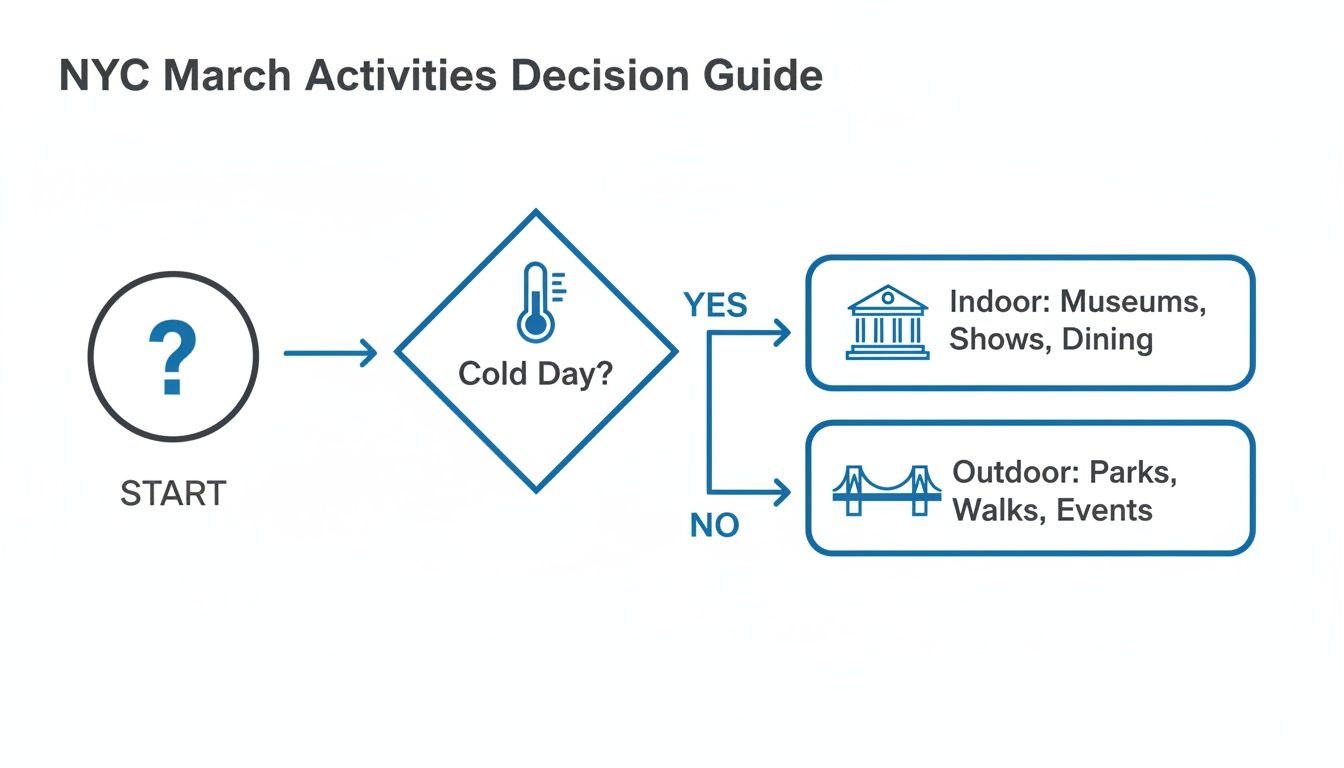
The big takeaway is that every day needs a built-in "Plan B." You should have a great indoor option ready to swap for an outdoor one if the weather turns.
The Weekend Warrior: A Packed 48-Hour Itinerary
This is for anyone on a tight schedule. You want to see the big sights efficiently, without the chaos. It's all about smart timing and using the subway like a local.
Day 1: Midtown Icons & Theatrical Heights
- Timing Tip (8:30 AM): Get to the Top of the Rock first thing. Seriously. The views of Central Park are better than from the Empire State Building, and their timed entry is less of a mob scene. Big crowds start arriving around 10:30 AM.
- Late Morning (11:00 AM): Stroll to Bryant Park. Grab a coffee, then pop into the New York Public Library to see the Rose Main Reading Room. It’s a perfect, free indoor escape if the wind starts biting.
- Afternoon (1:00 PM): Lunch in Hell's Kitchen. Skip the tourist-trap chains in Times Square and walk a few blocks west. You'll find dozens of authentic food options on Ninth Avenue.
- Evening (7:00 PM): A Broadway show. Book tickets well in advance for decent prices. Afterward, the neon chaos of Times Square at night is worth seeing once—then get out.
Day 2: Downtown History & Brooklyn Views
- Morning (9:00 AM): Hop on the ferry to the Statue of Liberty and Ellis Island. This will eat up most of your morning. Book the very first ferry of the day to keep wait times manageable.
- Afternoon (2:00 PM): Head to the 9/11 Memorial & Museum. It's a heavy, somber, but powerful experience. Give yourself at least two to three hours; it's essential for understanding modern NYC.
- Late Afternoon (5:00 PM): Walk across the Brooklyn Bridge, from Manhattan to Brooklyn. The sun will start setting behind you, lighting up the downtown skyline. It will be cold, so dress for it.
- Evening (7:00 PM): Dinner in DUMBO. Reward yourself with pizza from a legendary spot like Grimaldi's or Juliana's. The view of the Manhattan skyline from this side is unbeatable.
The Relaxed Explorer: A Slower-Paced Journey
If you'd rather soak up the vibe of a few neighborhoods instead of sprinting between landmarks, this is for you.
Day 1: Greenwich Village & Chelsea Market
- Morning: Get lost in the West Village. Start at Washington Square Park, watch the street performers, then meander through the brownstone-lined streets. Let yourself stumble upon little bookshops and cafes.
- Afternoon: Walk the High Line. Start in the Meatpacking District and head north. It’s a repurposed park on an old elevated railway that gives you a unique perspective of the city. In March, it won't be as crowded as in summer.
- Late Afternoon: Dive into Chelsea Market. When you get cold, this is your sanctuary. It’s a massive indoor food hall with some of the best eats in the city. You could spend hours grazing.
Day 2: Upper West Side Culture
- Morning: Explore the American Museum of Natural History. It’s gigantic, so don’t try to see it all. Pick a few exhibits—the dinosaur fossils and the Milstein Hall of Ocean Life are standouts.
- Afternoon: Take a quiet walk through Central Park. From the museum, you can enter the park and head toward Strawberry Fields. The western side of the park is generally quieter and more local than the areas bordering Fifth Avenue.
- Evening: Enjoy dinner and a show at Lincoln Center. Check what's playing at the Metropolitan Opera or the New York City Ballet. Even if you don't go inside, the campus is beautiful to walk around at night.
If these templates aren't quite right, you can get a head start by learning how to create a travel itinerary that matches your own pace. That’s the secret to avoiding that "I'm on someone else's vacation" feeling.
The First-Time Family: A Kid-Friendly Plan
This itinerary balances iconic sights with activities designed to keep younger travelers from getting bored. It also has downtime built in to prevent meltdowns.
Day 1: Boats, Buildings & Broadway
- Morning: Take a Circle Line Sightseeing Cruise. For kids, this is a great way to see the Statue of Liberty and the skyline without the logistical nightmare of multiple ferry lines. They can move around, and you get a break from walking.
- Afternoon: Visit the Intrepid Sea, Air & Space Museum. It's on a real aircraft carrier, which is cool enough, but the exhibits are a massive hit with kids. The Space Shuttle Enterprise is a genuine jaw-dropper.
- Evening: See a family-friendly Broadway show like The Lion King or Wicked. The sheer spectacle holds a kid's attention. Have an early dinner beforehand to avoid a late night.
Day 2: Dinosaurs, Toys & Central Park
- Morning: Make a beeline for the American Museum of Natural History. Your mission: get straight to the fourth floor. The dinosaur exhibits are legendary and a guaranteed win. Don't try to tackle the whole museum.
- Afternoon: Let them run wild in Central Park. After being in a museum, head to a nearby playground. If the weather is decent, a ride on the historic carousel is practically a requirement.
- Late Afternoon: Brace yourself for a stop at FAO Schwarz at Rockefeller Center. Yes, it’s sensory overload, but it’s also a classic NYC kid experience. Just be prepared for the "Can I have this?!" requests.
A Reality Check on Prices and Traps
Let's talk money. A trip to New York City is never cheap, but visiting in March requires specific financial planning. Here’s the blunt truth you need to budget properly and sidestep the classic mistakes.
<iframe width="100%" style="aspect-ratio: 16 / 9;" src="https://www.youtube.com/embed/VXoQyC9-DC8" frameborder="0" allow="autoplay; encrypted-media" allowfullscreen></iframe>While March is more affordable than the summer or holiday seasons, you shouldn't expect rock-bottom discounts. The city is starting to wake up, and prices are, too. This isn't the sleepy off-season you might find elsewhere.
The WanderAssist Reality Check
Price Warning: What a Good Deal Actually Looks Like
The biggest sticker shock for most first-timers is accommodation. Hotel prices are structurally higher than they were a few years ago. By early 2025, New York City had about 135,000 hotel rooms, but intense demand meant that average daily rates in 2024 had already shot up 28.7% compared to pre-pandemic 2019. You can read more about the city's tourism economy and see what that means for your budget.
So, what does a "good" price look like? If you find a decent hotel in a safe, convenient neighborhood for under $250 per night in March, book it. Anything around $200 is a fantastic deal. Don't burn daylight searching for a mythical $150 room in a good part of Manhattan—it's likely not in a location you'll be happy with.
Here’s a realistic breakdown of daily expenses:
- Food: You can scrape by on $75 a day if you're hitting slice shops and food carts. For a more comfortable budget that includes a casual sit-down dinner, plan on $125-$150 per person.
- Transit: The OMNY system is easy. Just tap your contactless card or phone. Plan for about $10-$15 per day on the subway and bus.
- Activities: This number varies, but budget at least $50 per day per person. One ticket to an observation deck can eat that up in a single go.
Tourist Trap to Avoid: The Times Square Food Vortex
The single biggest tourist trap in New York isn't a place—it's a mindset. It's the belief that you have to eat right next to Times Square because it's "convenient." It's not. It's a vortex designed to serve you overpriced, mediocre food in a chaotic setting.
Last time I was in NYC with a first-timer, he fell right into it. We were near Times Square after a show, starving, and he insisted we just grab a bite right there. We ended up at a generic chain, paid $28 for a burger I can't even remember, and were rushed out in 40 minutes. The next night, we walked ten minutes to Hell's Kitchen and had an amazing Thai dinner for half the price.
Here's the secret: walking just three blocks in any direction away from the glowing heart of Times Square will improve your dining options by 100%. Don't let convenience trick you into a bad, expensive meal.
What Are Some Other Lingering Questions About March in NYC?
Once you’ve got a handle on the weather and a rough plan, a few practical questions always come up. Let's tackle them so you can head to New York feeling prepared.
Is the St. Patrick's Day Parade Worth It?
Unless you have a specific, personal reason to be there, you should actively avoid the St. Patrick's Day Parade. For a visitor, it’s not a charming cultural event; it’s a logistical mess.
The parade shuts down a massive stretch of Fifth Avenue on March 17th, turning Midtown into a grid of street closures and enormous, often very drunk, crowds. If your hotel is near the route, just getting back to your room can be a challenge. My advice? Acknowledge it's happening, then get as far away as you can. Head downtown, hop over to Brooklyn, or explore a museum. You'll have a much better day.
How Do I Ride the Subway Without Looking Like a Tourist?
The subway is the heart of New York, and you should use it. It can look intimidating, but it's safer and more efficient than its reputation suggests. The trick is to move with purpose.
- Plan Your Route Above Ground: Don't be the person frozen at the turnstiles, staring at a map on your phone. Figure out your train and your direction (uptown or downtown?) before you even walk down the station stairs.
- Secure Your Stuff: This is just basic big-city smarts. Keep your phone in a front pocket, zip your bag, and hold it in front of you on a crowded car.
- Stay Alert: Pop one earbud out so you can hear what’s going on. If you're traveling late, wait near the "off-hours waiting area," which is usually centrally located and monitored.
The single biggest mistake first-timers make isn't getting on the wrong line—it’s hopping on the express train when they needed the local. Look at the sign on the side of the train car before you get on. It will save you from shooting ten blocks past your destination.
Where Are All the Good, Cheap Eats?
New York's best food is rarely found in the most famous places. To eat well without blowing your budget, think like a local. Get away from the tourist traps and eat where New Yorkers grab lunch.
My go-to strategy is to walk a few avenues away from the main attraction. Instead of a mediocre meal near Times Square, walk to Hell's Kitchen. Skip the pricey spots in SoHo and head for the restaurants in the East Village or Lower East Side.
Here are a few can't-miss options for great food that won't break the bank:
- Chinatown & Koreatown: Home to some of the best-value dumplings, noodles, and Korean BBQ.
- Food Halls: Places like Essex Market on the Lower East Side or Industry City in Brooklyn are fantastic. They offer a ton of variety from different vendors.
- A Classic Slice: Seriously. A proper New York slice is a cultural rite of passage. For $3-$5, it’s still one of the most satisfying and affordable meals in the city.
Discovering these places is part of the fun. By venturing just a little off the beaten path, you’ll find better food for a fairer price.
Feeling overwhelmed by all the moving parts? The WanderAssist 60-second planner is designed to eliminate that decision fatigue. It builds a smart, reality-aware itinerary that handles the timing and logistics, so you can focus on actually enjoying New York. Get your personalized plan at WanderAssist.com.