
How to Create a Travel Itinerary That Actually Works

Learn how to create a travel itinerary that avoids tourist traps and burnout. Our guide helps you build a realistic, day-by-day plan that feels like a vacation.
The secret to a great travel itinerary isn't a massive checklist of things to see. It’s a smart schedule built on two simple things: timing and location. When you anchor your plans in walkable neighborhoods and group sights together, you build a trip that feels calm and immersive, not like a frantic scramble.
Your 60-Second Answer Block
Stop trying to see everything. Seriously. A good itinerary mixes a few key attractions with actual downtime, all grouped by neighborhood to cut down on transit fatigue. For a trip to Rome, for instance, this means anchoring a day in Trastevere and hitting the Pantheon early or late to dodge the midday heat and crowds. It’s about experiencing more, not just seeing more.
I learned this the hard way, sprinting between the Colosseum and the Vatican in the sweltering sun. I was wiped out by 3 PM. Now, I accept I'll see fewer things, but I enjoy what I do see so much more. This method isn’t about a rigid, minute-by-minute schedule. It's a flexible framework that cuts down on travel fatigue and maximizes actual enjoyment.
If that sounds like a recipe for decision fatigue, the WanderAssist 60-second planner generates a solid, time-aware foundation you can tweak. It’s about working smarter, not harder.
Why is the old way of planning so bad?
This simple shift in mindset—from a simple to-do list to a time-aware schedule—is a game-changer. Here’s what that looks like in practice.
| Planning Element | The Old Way (Checklist Method) | The Smart Way (Timing Method) |
|---|---|---|
| Pacing | Tries to cram in as much as possible, leading to burnout. | Focuses on a sustainable pace with built-in breaks. |
| Geography | Sights are listed randomly, causing constant backtracking. | Attractions are grouped by neighborhood to save transit time. |
| Timing | Ignores peak hours, leading to hours wasted in long lines. | Visits popular spots during shoulder times (early/late). |
| Flexibility | A delayed train or closed museum derails the entire day. | Leaves room for spontaneity and unexpected discoveries. |
Ultimately, the goal isn't just to see a city, but to feel it. The smart way gives you the structure to do just that without burning out.
Why Do Most Travel Itineraries Fail?
Let’s be honest. Most travel itineraries you find online are just glorified checklists. They look fantastic on a spreadsheet but completely fall apart on the cobblestone streets because they ignore the three things that actually matter: timing, transit, and energy.
A typical plan might cram three museums, a walking tour, and a famous landmark into a single day. It conveniently forgets about the hour-long queue that snakes around the block, the 30-minute subway ride between neighborhoods, and the simple fact that you are a human who needs to eat, rest, and maybe just sit on a bench for a minute. This is how trips turn into a frantic scramble from one place to the next.
What's wrong with the checklist approach?
The core problem is the "checklist" mentality. We create a list of sights and then try to connect the dots, often crisscrossing a city multiple times a day. This approach completely ignores a critical concept I call travel friction.
Travel friction is all the unseen time and energy you bleed just getting from Point A to Point B. It’s the 15 minutes spent figuring out a confusing metro map, the 20 minutes stuck in gridlock traffic, and the 10 minutes you wander around looking for the actual museum entrance. Add them up, and they can easily chew up hours of your precious vacation time.
Last time I was in Paris, I watched a family have a full-on meltdown outside the Louvre. They’d just spent 45 minutes on the metro from Montmartre, only to face a two-hour queue in the sweltering sun. Their itinerary was technically possible, but it had no connection to reality.
Are crowds and costs really that much worse now?
Yes. With international travel roaring back, popular cities are more congested than ever. A recent AAA report revealed that international trip bookings skyrocketed by 200% in 2023. Hotspots like London saw a 350% spike in bookings alone. You can find more of AAA's insights on post-pandemic travel trends here. Without a smart plan, you're just paying premium prices to stand in a line.
Underestimating crowd density is a classic mistake. That serene-looking photo you saw of the Trevi Fountain? It was probably taken at 6 AM. Show up at 2 PM, and you’ll be fighting a wall of people just to catch a glimpse. A great trip is one that serves you, not one that serves a checklist.
How Do I Build an Itinerary From Scratch?
Alright, let’s get into the nitty-gritty. A truly great itinerary isn’t just a checklist; it's a smart framework built on geography and time. This is where you switch from thinking like a tourist to thinking like a local who gets the city’s pulse. The whole approach boils down to two simple ideas: Neighborhood Anchoring and Temporal Logic.
Step 1: Master Neighborhood Anchoring
Forget listing every single museum and monument. Instead, pick one primary neighborhood to be your home base for each day. Just one. This simple decision is the single best way to cut down on travel fatigue. You stop crisscrossing the city like a pinball and start immersing yourself in one specific zone.
This strategy forces you to see a city for what it is: a collection of distinct villages. A day anchored in Le Marais in Paris feels completely different from a day spent up in Montmartre. By staying in one area, you trade time wasted on the metro for time spent actually enjoying the sound of local chatter and the smell of roasting coffee from a corner cafe.
Step 2: Apply Temporal Logic to Your Day
Once you've chosen your neighborhood anchor, you start thinking about timing. This means strategically planning your visit to the main attraction for its quietest hours. Almost without fail, this is either the first hour after opening or the last hour before closing. Rocking up to the Uffizi Gallery in Florence at 11 AM is asking for a two-hour line. Getting there 15 minutes before the doors open? A totally different world.
This is the key to avoiding the most common trip-ruining mistakes.
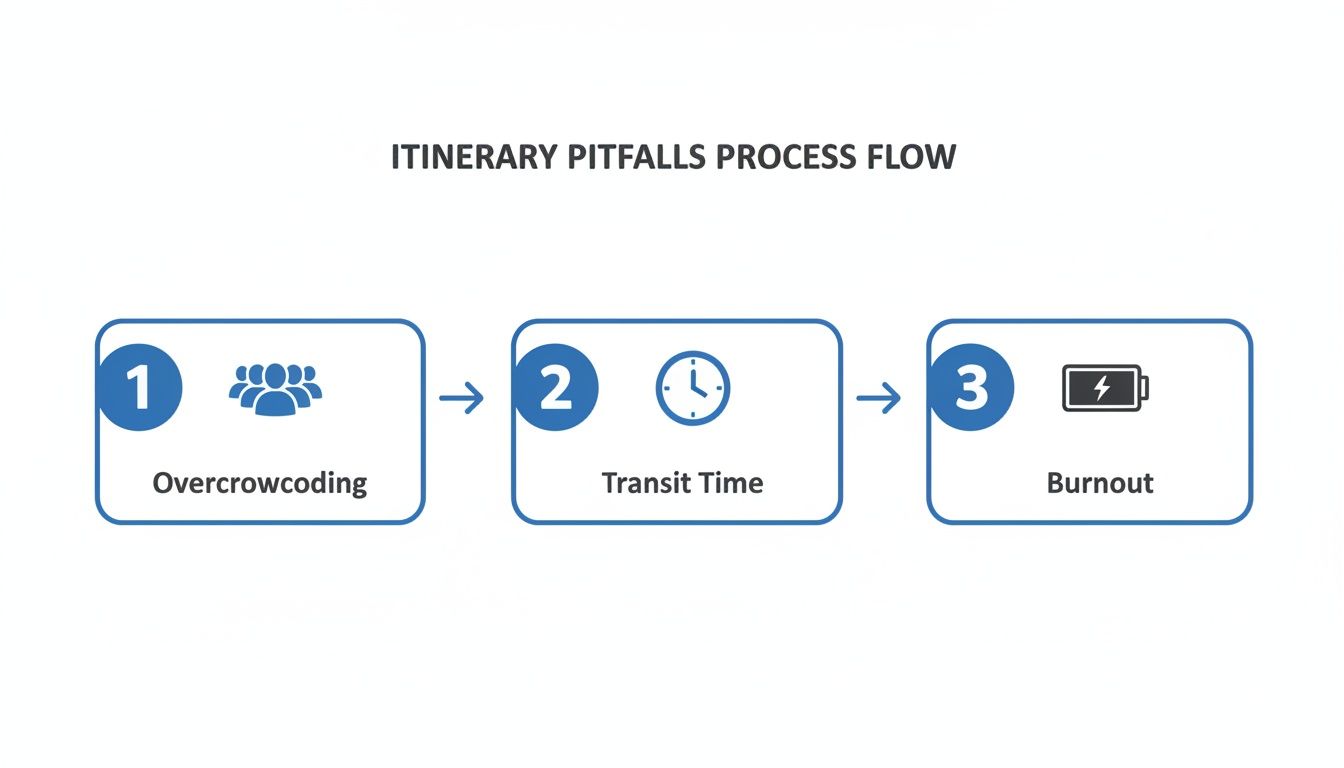
These problems are all connected. Overcrowding leads to wasted time, which leads to burnout—a frustrating cycle.
The rest of your day is then loosely blocked out into Morning, Afternoon, and Evening slots. You fill these with smaller sights, meals, and—this is critical—planned downtime, all within that same walkable district.
This isn’t a rigid, minute-by-minute military plan. Think of it as a flexible container. It gives you structure but leaves plenty of room to discover a hidden alleyway or linger over a coffee without feeling like you’ve messed up the schedule.
Here’s what this looks like for a day in Kyoto, anchored in the Gion district:
- Morning (7:30 AM): Get to Fushimi Inari Shrine. Starting this early means you experience the torii gates with just a fraction of the midday crowds.
- Late Morning (10:30 AM): A slow walk through the historic streets of the Higashiyama district, making your way back toward Gion.
- Afternoon: Lunch in Gion, then head up to Kiyomizu-dera Temple.
- Evening: Explore the narrow Pontocho Alley for dinner as the lanterns begin to glow.
See how it all flows? Everything is geographically connected. This method is the foundation for creating a truly personalized travel itinerary that feels both efficient and wonderfully unhurried.
Can AI Tools Help Plan a Better Trip?
<iframe width="100%" style="aspect-ratio: 16 / 9;" src="https://www.youtube.com/embed/WPN5psmGZLs" frameborder="0" allow="autoplay; encrypted-media" allowfullscreen></iframe>Let's be blunt about most AI itinerary planners. They’re basically just glorified list-makers. They'll spit out the same generic, overcrowded tourist spots without a shred of real-world context.
They’ll tell you to visit the Louvre, but won't mention that using the Carrousel entrance can save you an hour in line, or that going on a Tuesday is a non-starter because it's closed. This is where most tools fall flat. The trick is to use AI as a strategist, not just a list-generator. A genuinely helpful tool doesn't just tell you what to see; it helps you figure out when and in what order to see it, sequencing them based on crowd data, opening hours, and simple walkability. This is where the right tool can save you hours of mind-numbing research.
How should I actually use an AI planner?
Think of a smart AI planner as your research assistant, not your travel agent. Its job is to hand you a solid, logically sound foundation that you can then tear apart and rebuild to your liking. The goal is to get a workable draft in minutes, not a perfect, unchangeable plan.
A tool like the WanderAssist 60-second planner is built on this very idea. It gives you a schedule that’s already aware of smart timing and neighborhood anchoring. Once you have that foundation, you can start asking the right questions to make it yours.
- Is this pace realistic for me? Maybe the AI suggests three museums, but you'd rather spend that entire time at one cafe. Do it.
- Is this attraction actually my kind of thing? Just because something is famous doesn't mean you have to see it. Swap that "must-see" for a quirky bookstore you're actually excited about.
- What's missing? Use the time you saved on logistics to hunt down that hole-in-the-wall taco spot you heard about from a friend.
The real power of AI is in fast-tracking the tedious parts. It nails the initial structure, so you can pour your energy into the personal touches that make the trip uniquely yours.
Why does this matter more than ever?
The shift to digital-first travel planning is undeniable. A 2023 Statista survey found that 86% of Millennials consider booking their trips entirely online essential. This points to a huge demand for tools that deliver fast, usable schedules without the headache of a dozen open browser tabs. For more on this, you can explore the full Statista findings on traveler booking preferences.
This is precisely why a smarter approach to AI is so important. You need tools that respect your time and intelligence. Instead of adding to the noise with another generic checklist, a good AI travel planner gives you a realistic framework.
The WanderAssist Reality Check
Let’s get one thing straight. Every city has its tourist traps—those overhyped spots that look incredible on Instagram but feel like a massive letdown in person. Here’s the truth about a common itinerary mistake.
Think about that “famous” food market plastered all over social media. The reality? It’s probably a gridlocked tourist hub selling overpriced, factory-made snacks. Instead of fighting those crowds, ask a local shopkeeper for their favorite lunch spot a few streets over. That’s where you find the real flavor of a city.
Ditch the Traps for Linger Zones
A great itinerary isn't just about what you see; it's about what you don't do. It's about consciously skipping the high-pressure, low-reward activities. I can’t stress enough the importance of building in "Linger Zones"—parks, quiet cafes, or neighborhood plazas where you can just sit, recharge, and absorb the city’s actual rhythm.
Price Warning: Be wary of restaurants right next to major landmarks. The food is almost always mediocre and the prices are inflated by 20-30%. Walk just five minutes away from the main square, and you'll find better food for a fraction of the cost.
How do I survive the post-pandemic crowds?
With travel booming again, planning an itinerary that dodges the masses is more critical than ever. In 2023, international departures by US citizens jumped by 22%, hitting 98.5 million. That surge means that without a smart strategy for timing, you’re setting yourself up for disappointment. You can find more data on these international travel trends here. This is where the principles we’ve talked about—like visiting Paris's top spots before noon or after 4 PM—become non-negotiable.
The goal isn't to be cynical; it's to be realistic. It’s about getting the on-the-ground truth so you can make smarter decisions. Swapping one overhyped attraction for an hour of quiet observation in a local park will do more for your travel experience than a dozen checklist items ever could. When the planning feels overwhelming, remember the WanderAssist 60-second planner can build this smarter, reality-aware logic directly into your schedule.
A Few Common Itinerary Questions Answered
Even with the best method, some practical questions always pop up. Here are the honest answers to the ones I get asked most often.
How far in advance should I plan my trip?
Honestly, this comes down to your travel style, but there’s a sweet spot. For a big international trip, I start sketching out my neighborhood anchors and booking the must-haves about 2-3 months out. This handles the big logistical hurdles, like tickets for a museum or a timed event that you know will sell out.
But here’s the key: don't carve the day-by-day time blocks into stone until about a week before you leave. This gives you wiggle room to react to a grim weather forecast or a local festival that just got announced. For a spontaneous city break, you can pull a solid plan together in an evening with a tool like the WanderAssist planner.
How do I balance planning with spontaneity?
This is probably the most important question. The answer is simple: a good itinerary doesn't kill spontaneity; it creates the space for it.
Think about it. A rigid, minute-by-minute schedule is incredibly fragile. One subway delay can shatter the whole day. A "structured-flexible" plan, however, is resilient.
By using neighborhood anchoring, you’ve already done the hard part. Your plan might just say, "2–5 PM: Explore the Jordaan district in Amsterdam." The spontaneity comes from what you do within that block—whether you stumble into a hidden courtyard, wander into a quirky shop, or spend the entire three hours at a canal-side café.
The plan’s job is to get you to the right place at the right time. What happens when you get there is up to you.
What is the best format for an itinerary?
Forget those over-engineered spreadsheets you'll never actually open on the go. The best format is the one you will actually use, especially when you don't have Wi-Fi. A simple digital document in Google Docs or Apple Notes is perfect.
- Create a clear heading for each day (e.g., "Tuesday, October 22nd - Le Marais").
- Break the day into three chunks: Morning, Afternoon, and Evening.
- List your 1-2 anchor activities for each block with any booking confirmation numbers or addresses.
Most importantly, save an offline version or take screenshots of each day's plan. I learned this the hard way in Tokyo when the spotty subway Wi-Fi made my online plan impossible to access. Now, I always have a backup image saved on my phone. No signal, no problem.
What if my plans get disrupted?
They will. It's not a matter of "if," but "when." A train will be late, a museum will close, or you'll just wake up and not feel like rushing around. This is precisely why neighborhood anchoring is such a game-changer. If your morning plan falls through, you aren't stranded across town with a broken schedule. You're already in a great area full of other things to do. The trick is to have a few casual backup ideas for each neighborhood. It turns a potential moment of panic into a pleasant, unexpected detour.
Feeling the decision fatigue setting in? The WanderAssist 60-second planner builds all this reality-aware logic—neighborhood anchoring, smart timing, and built-in flexibility—into a solid foundation for your trip in under a minute. Get your personalized, burnout-proof plan here: https://wanderassist.com